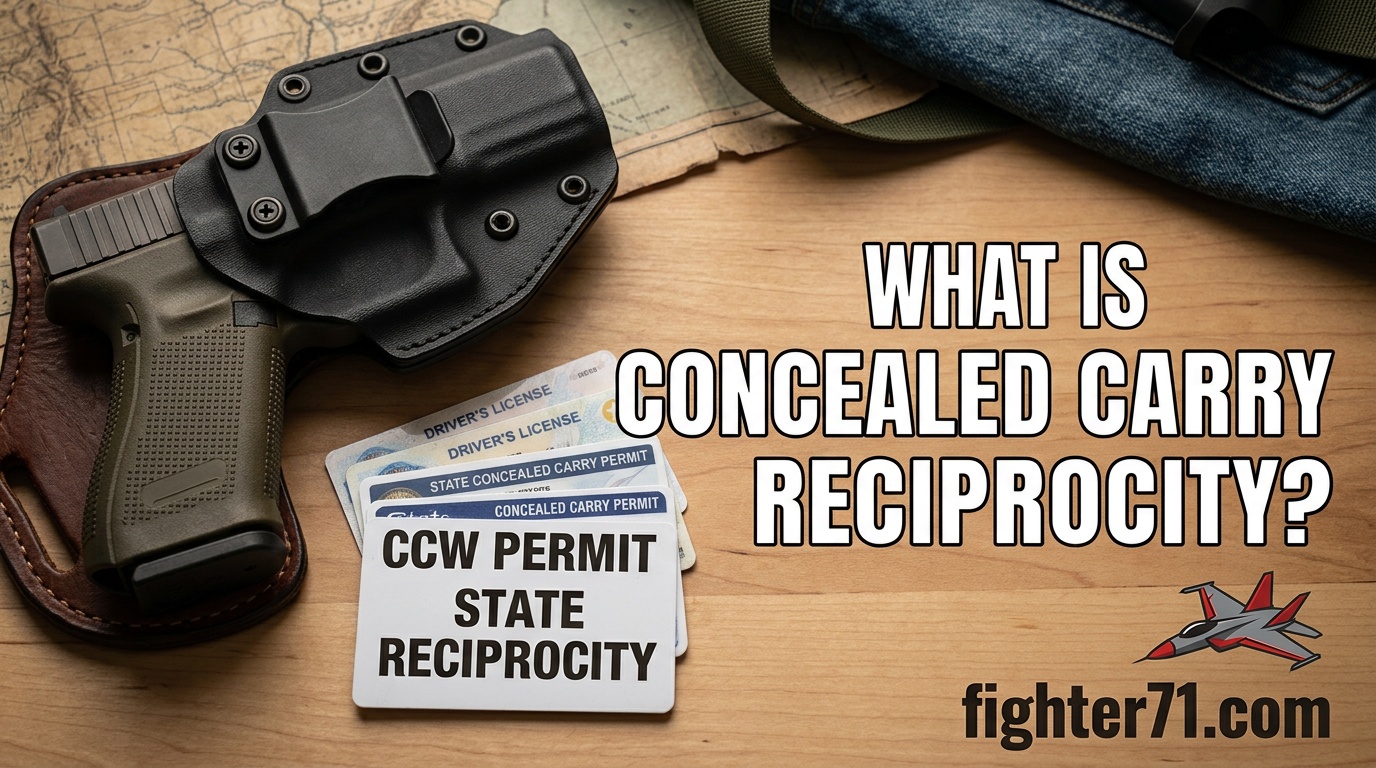
If you have a concealed carry permit, you need to understand reciprocity before you cross a single state line with your firearm. It’s not optional knowledge. Getting this wrong can turn a routine road trip into a felony stop, even if you’re a perfectly law-abiding gun owner back home.
This guide breaks down exactly what concealed carry reciprocity is, how it works across the United States, and what some of the most common state-specific questions actually mean for you as a permit holder.
What Does Concealed Carry Reciprocity Actually Mean?
Reciprocity, in the context of CCW, is the agreement between states to recognize each other’s carry permits. When two states reciprocate, a permit holder from one state can legally carry a concealed firearm in the other, and vice versa.
Think of it like a driver’s license. You get a license in one state, and every other state recognizes it. Concealed carry doesn’t work that way nationally, at least not yet. Instead, each state decides on its own which other states’ permits it will honor. Some states are very open about it. Others recognize almost nobody. And a few, like Maryland, don’t honor any out-of-state permits at all.
This is why checking reciprocity before you travel isn’t just good practice. It’s essential.
What States Are Reciprocal for Concealed Carry?
The short answer: it depends on your home state permit. There is no universal list.
Every state sets its own concealed carry requirements and decides which other states it will recognize. Some states honor permits broadly. Arizona, for example, honors concealed carry permits from all 50 states. Others honor only a handful. A few impose additional conditions, like requiring the permit holder to be at least 21 years of age, or only recognizing resident permits rather than non-resident ones.
The U.S. Concealed Carry Association (USCCA) and similar resources maintain up-to-date CCW reciprocity maps you can use to look up your specific state. Always verify directly, because firearms laws change, and reciprocity agreements can be added or revoked with little public notice.
How Does This Work Across State Lines?
Carrying a concealed firearm across state lines requires you to follow the laws of the state you are physically in, not the state that issued your permit. That’s the part people get wrong.
Say you live in Texas and have a Texas License to Carry. You’re driving through states to reach a family member in South Carolina. Even if every state along that route recognizes your Texas permit, you still have to follow each state’s individual gun laws. That means their magazine limits, their duty-to-inform rules, their list of prohibited locations. Your permit to carry a concealed weapon is recognized, but the laws of the state still govern how you carry.
Carolina concealed carry laws, for instance, differ from Texas laws in meaningful ways. Don’t assume your home state gun laws travel with you.
What Is the Constitutional Concealed Carry Reciprocity Act?
There’s currently a federal bill working through Congress called the Constitutional Concealed Carry Reciprocity Act. The House version is H.R. 38, and the Senate companion is S. 65. Both were introduced in early 2025.
If passed, the constitutional concealed carry reciprocity act would essentially create a national mandate requiring every state to recognize valid carry permits from any other state. It would also allow residents of permitless carry states to carry in any state that issues permits to its own residents. As of May 2026, the bill cleared the House Judiciary Committee but has not become law.
Critics argue it would override stricter state gun laws, including California’s, and be difficult for police to enforce, since officers would need to verify the permit requirements of 50 different states. Supporters say it would simplify the patchwork system and bring concealed carry in line with how driver’s licenses work.
Watch this one. It hasn’t passed yet, but it has real momentum in the current Congress.
Which States Honor the Virginia Concealed Carry Permit?
Virginia is a shall-issue state that offers both resident and non-resident permits. The Virginia concealed handgun permit is recognized by a large number of states, making it one of the more useful permits to hold.
Virginia honors valid out-of-state concealed carry permits from every U.S. state, as long as the permit holder is at least 21 years old and carries a government-issued photo ID. That makes Virginia quite permissive on the inbound side. On the outbound side, many states honor the Virginia permit, though some add conditions, like requiring you to be the state’s resident permit holder rather than a non-resident permit holder. Always contact the state directly or verify through the Virginia State Police’s reciprocity page before carrying there.
One recent update worth knowing: in June 2025, Virginia and Pennsylvania renewed their reciprocity agreement, restoring mutual recognition after it had lapsed.
How Many States Does Maryland CCW Cover?
This one surprises a lot of people. Maryland is one of the strictest states in the country when it comes to concealed carry reciprocity.
Maryland does not honor permits from any other state. If you have a concealed carry permit from Texas, Florida, or anywhere else, it is not valid in Maryland. You need a Maryland Wear and Carry Handgun Permit to legally carry a concealed firearm there.
On the flip side, Maryland’s own permit is recognized by around 26 states. So if you have a Maryland CCW, you can carry in roughly half the country, but Maryland itself functions as a closed system when it comes to accepting out-of-state permits. Open carry is also prohibited in Maryland as of October 2023, adding another layer of restriction.
This is exactly why you need to verify state-specific rules before you travel, not assume that a valid permit anywhere means a valid permit everywhere.
How Many States Does Arizona Concealed Carry Cover?
Arizona is on the opposite end of the spectrum from Maryland. It’s one of the most carry-friendly states in the country.
Arizona honors concealed carry permits from all 50 states, and it also has permitless carry, meaning any person who is at least 21 years old and legally allowed to possess a firearm may carry concealed without a permit at all. For Arizona residents who do get a permit, that permit is recognized in approximately 38 states. Non-residents holding an Arizona permit can carry in roughly 31 states, since some states will only honor permits from the holder’s state of residence.
The Arizona permit is often cited as one of the best non-resident permits to obtain, alongside Utah and Florida, because of how broadly it is recognized. If you want to carry in as many states as possible, getting an Arizona permit, even as a non-resident, is worth looking into.
What Is Permitless Carry and How Does It Affect Reciprocity?
Permitless carry, also called constitutional carry, means that a state allows residents to carry a concealed firearm without obtaining a permit first. As of 2025, 29 states have permitless carry laws in some form.
This creates an interesting situation for reciprocity. If you live in a permitless carry state and don’t have a formal permit, you generally cannot use reciprocity to carry in states that require a permit. Most states that recognize out-of-state permits want to see an actual permit, not just proof that your home state doesn’t require one. This is why residents of constitutional carry states often still get a permit even though they don’t legally need one at home. Having that valid concealed carry permit gives you the ability to carry legally in states that reciprocate.
Some states don’t require a permit to carry but still issue them voluntarily, specifically for this reason.
Does Colorado Have Concealed Carry Reciprocity?
Colorado is a shall-issue state when it comes to concealed handgun permits. The Colorado bureau of investigation handles background check requirements for private transfers, and permits are issued through county sheriff’s offices.
Colorado has reciprocity with approximately 33 states, but it’s selective about which permits it will honor. Colorado will only recognize resident permits from states with which it has a formal reciprocity agreement. If your home state has a non-resident permit only, Colorado won’t accept it. Colorado also does not issue non-resident permits to most applicants, with the exception of active-duty military and their immediate families permanently stationed there.
One other key point for Colorado: Denver County has additional firearm restrictions that differ from state law. Even if you may carry legally under Colorado state rules, Denver’s local ordinances can limit where and how you carry. State law does not fully preempt local restrictions there.
Tips for Carrying Legally Across State Lines
Before you travel with a firearm, here’s how to stay legal and stay smart.
Always verify current reciprocity status directly with the state you’re visiting. Laws change. A state that honored your permit last year might not this year. The USCCA reciprocity map and similar tools are useful starting points, but the state’s official website or attorney general’s office is the authoritative source. You can also contact the state directly to confirm.
Know the local rules, not just whether you’re allowed to carry. Check prohibited locations, duty-to-inform requirements, magazine limits, and vehicle carry rules. Carrying a loaded gun in public comes with different rules in different places. What’s legal in one state may be a serious offense in another.
Carry your permit and a government-issued photo ID at all times when you’re carrying. Most reciprocity agreements require both.
Resources like the USCCA, the NRA’s state law database, and handgunlaw.us are solid references. USCCA members also get access to legal defense coverage, which is worth considering if you carry regularly across state lines.
The Bottom Line on CCW Reciprocity
- Concealed carry reciprocity means one state agrees to honor another state’s permit
- There is no universal national reciprocity yet, though the Constitutional Concealed Carry Reciprocity Act (H.R. 38) is working through Congress
- You must follow the gun laws of the state you are in, regardless of where your permit was issued
- Arizona honors all 50 states’ permits and has broad reciprocity; Maryland honors none
- Virginia’s concealed handgun permit is recognized by many states but always verify current agreements
- A Maryland CCW covers roughly 26 states, but Maryland itself does not accept out-of-state permits
- An Arizona resident permit covers approximately 38 states; non-residents get around 31
- Permitless carry states allow carry without a permit, but that does not equal reciprocity in other states
- Colorado has reciprocity with roughly 33 states but only accepts resident permits from those states
- Always verify before you travel, not after
About the Author