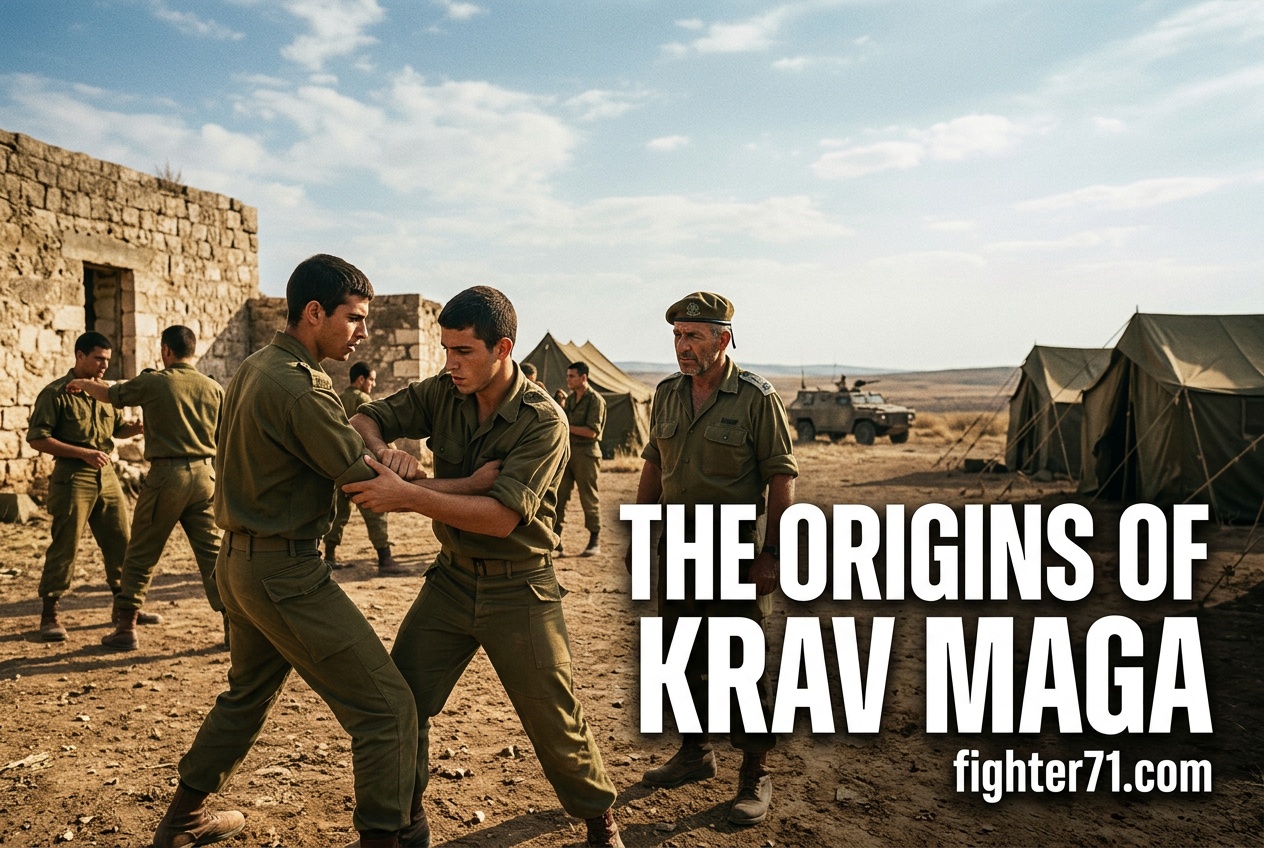
TL;DR: Krav Maga is an Israeli self-defense system developed by Imi Lichtenfeld in the 1930s and 40s, born from real street fighting against anti-Semitic gangs in Bratislava, Czechoslovakia. After moving to Palestine, Lichtenfeld refined the system into the official combat training of the Israel Defense Forces (IDF). Today it’s taught everywhere from elite military units to civilian gyms in the United States. The catch? There’s legitimate Krav Maga and there’s Bullshido Krav Maga, and the difference matters more than most people realize.
If you’ve ever wondered what is Krav Maga, where it actually came from, or why it has such a polarized reputation in the martial arts and combat sports community, this is the breakdown you’ve been looking for. The history of Krav Maga is more interesting than the marketing suggests.
What Is Krav Maga?
Krav Maga, which translates roughly to “contact combat” in Hebrew, is a practical self-defense system designed for real-world violence. Unlike traditional martial arts that focus on choreographed forms, belt rankings, and competition rules, Krav Maga is built around one principle: end the fight as fast as possible and get home alive. There are no points, no judges, no rounds. Just techniques drawn from boxing, wrestling, jiu jitsu, jujutsu craft, judo, and street fighting, all stripped down to what works under stress.
The system emphasizes simultaneous defense and offense, attacking vulnerable targets, and using whatever’s available. Strikes to the eyes, throat, groin, and knees are central. Krav Maga training also focuses heavily on situational awareness, de-escalation, and recognizing threats before they become physical. It’s a fighting style designed for civilians who don’t want to fight, soldiers who have to, and law enforcement who deal with violence as part of the job.
Who Invented Krav Maga?
The founder of Krav Maga is Imi Lichtenfeld, a Hungarian-Jewish boxer, wrestler, and gymnast born in 1910 in Budapest and raised in Bratislava, then part of Czechoslovakia. Lichtenfeld’s father was a chief detective and self-defense instructor for the local police, and Imi grew up training in boxing, wrestling, and gymnastics under his father’s guidance. By his teens, he was a competitive athlete winning national titles in multiple disciplines.
The seeds of Krav Maga were planted in the mid-1930s when fascist and anti-Semitic gangs began terrorizing the Jewish community in Bratislava. Lichtenfeld led groups of young Jewish men in defending their neighborhoods, and that’s when he learned a hard truth. Competitive martial arts and boxing had rules. Street fighting did not. The techniques that won him gold medals in the ring failed him on the cobblestones. He started rebuilding his fighting system from scratch, focused entirely on what worked when an opponent had no intention of playing fair.
That rebuilding process is where Krav Maga began. Lichtenfeld kept what was effective from boxing, wrestling, and various martial arts, threw out everything tied to sport rules, and added techniques designed for outnumbered, outweighed, and unarmed-versus-armed scenarios.
How Did Krav Maga Get to Israel?
When World War II broke out, Lichtenfeld fled Czechoslovakia and eventually made his way to Palestine in 1942 after a harrowing journey that included time on a refugee ship. Once there, he joined the Haganah, the Jewish paramilitary organization that would later become the Israel Defense Forces. The Haganah commanders quickly recognized Lichtenfeld’s combat skills and asked him to teach hand-to-hand combat to their fighters.
When the State of Israel was officially established in 1948, the IDF formed and Lichtenfeld became its chief instructor for physical fitness and Krav Maga. He spent the next two decades developing and refining the system specifically for military use. The challenge was unique. Israel needed to take civilians from every background, including immigrants with no fighting experience, and turn them into capable soldiers in minimal training time. Krav Maga had to be learnable fast, retainable under stress, and effective for everyone from a 19-year-old conscript to a hardened special forces operator.
This is where the modern system of Krav Maga really took shape. Every technique had to pass three tests. Did it work? Could it be taught quickly? Would a soldier remember it under fire? If the answer to any of those was no, the technique was cut.
When Did Krav Maga Spread to Civilians?
Lichtenfeld retired from active IDF service in 1964 but stayed on as chief instructor at the IDF’s training center for years afterward. In the late 1960s and 1970s, he began teaching Krav Maga to civilians, recognizing that ordinary people facing street violence needed the same tools soldiers used. He opened a training center in Netanya, Israel, and started certifying civilian instructors.
The first Krav Maga course for civilian instructors ran in 1971, and the system began to spread internationally throughout the 1980s. Lichtenfeld’s senior students, including names like Eyal Yanilov, Darren Levine, and Haim Gidon, took the system abroad and established schools in Europe and the United States. Krav Maga Worldwide, founded by Levine in Los Angeles, became one of the most influential organizations spreading the system across North America. The International Krav Maga Federation under Yanilov took on the global expansion. The Israeli Krav Maga Association continued to oversee the system within Israel itself.
By the 2000s, Krav Maga classes were available in nearly every major city in the United States and across Europe. The system Lichtenfeld built in a Bratislava alley had become a global self-defense phenomenon.
Is Krav Maga Russian or Israeli?
Krav Maga is Israeli, full stop. The confusion sometimes comes from people mixing it up with Systema, which is a Russian martial art with completely different origins and methodology. Krav Maga was developed by a Hungarian-Jewish immigrant in pre-state Palestine and refined into its modern form within the Israel Defense Forces after the State of Israel was established in 1948. Every recognized lineage of authentic Krav Maga traces back to Imi Lichtenfeld and the Israeli military and civilian schools that followed him.
The Israeli identity is more than geographic. It’s baked into the system’s design philosophy. Krav Maga assumes outnumbered scenarios, weapon-equipped attackers, and the kind of asymmetric violence that defined the Israeli security environment for decades. That’s why so many techniques focus on knife defense, gun disarms, and multiple-attacker situations. The system was built for the threats Israel actually faced, not theoretical sparring matches. Krav Maga is Israeli to its bones.
Is Krav Maga Useful in a Real Fight?
Yes, legitimate Krav Maga is genuinely useful in a real fight, and that’s not marketing fluff. Schools like 360 Krav Maga and other reputable training centers teach the same fundamentals that make boxing, wrestling, and jiu jitsu effective: footwork, distance management, leverage, conditioning, and practical drilling under pressure. The difference is that Krav Maga adds techniques and scenarios traditional martial arts and combat sports don’t cover. Hammer fists thrown when an attacker is off to your side rather than directly in front. Ground kicks designed to create space when you’ve been knocked down. Defenses against weapons drawn at conversational distance. Real-life combat scenarios that competition rules would never allow.
The catch is that there’s a complete industry of Bullshido Krav Maga, and it has poisoned the system’s reputation. People like Roy Elghanayan and his REKM brand have built large followings on Hollywood-style demos featuring choreographed disarms, flashy techniques, and unrealistic compliance from training partners. These demos look impressive on Instagram. They fall apart in actual contact. When most people hear “Krav Maga,” that’s what they picture, and that’s why the system gets dismissed by serious martial artists. Authentic Krav Maga taught by qualified instructors with real pressure-tested training is a legitimate self-defense system. Choreographed Krav Maga theater is not. The trick is knowing the difference, and the difference usually shows up the moment a student spars with full resistance.
Why Is Krav Maga Not Taken Seriously?
Krav Maga isn’t taken seriously by parts of the martial arts community for two reasons. The first is the Bullshido factor. The system has attracted more than its share of charlatans, fake “Israeli special forces” instructors, and McDojo operators who slap a Krav Maga banner on whatever loose collection of techniques they’re selling. Without competitive sparring, full-contact pressure testing, or a regulating body that enforces standards, anyone can claim to teach Krav Maga. Compare that to BJJ, where rank is earned through years of live rolling against resisting opponents, and the credibility gap becomes obvious. Boxing and Muay Thai practitioners can point to fight records. Many Krav Maga instructors can only point to certificates.
The second reason is the lack of pressure testing in many schools. Without sparring, technique drills can become rituals rather than skills. Unlike traditional martial arts that test through forms or competitive martial arts that test in the ring, Krav Maga sometimes skips testing entirely, which lets bad technique survive. The legitimate side of the system, including the Krav Maga Association of America, Krav Maga Worldwide, and the Israeli Krav Maga Association, addresses this with hard sparring, scenario drills, and stress inoculation. The fly-by-night side does not. When critics dismiss Krav Maga as “not real,” they’re usually thinking of the latter group. They’re not wrong about that group. They are wrong about the system as a whole.
What Is the Oldest Martial Art on Earth?
The oldest martial art on earth is generally considered to be a form of wrestling, and the strongest claim historically goes to Pehlwani or its ancestors in the Indian subcontinent, with depictions dating back over 5,000 years. Sumerian and Egyptian carvings show wrestling matches from the 3rd millennium BCE. Greek pankration, a brutal hand-to-hand combat system combining wrestling and striking, dates back to at least 648 BCE when it was introduced to the Olympic Games.
For pure striking arts, ancient boxing also has claims going back thousands of years. Chinese martial arts traditions like Shuai Jiao have similarly ancient roots. The honest answer is that wrestling and grappling-based fighting systems are almost certainly the oldest martial arts because they emerged from natural human movement long before anyone formalized them as systems. Krav Maga, by comparison, is a modern self-defense system. Its roots in boxing, wrestling, and jujutsu craft connect it to ancient combat traditions, but as a defined system, it’s barely 80 years old. That’s part of why it works so well. It draws from thousands of years of refined combat knowledge and applies it to modern violence.
How Did Krav Maga Reach the United States?
Krav Maga arrived in the United States in the 1980s primarily through Darren Levine, an American martial artist who trained directly under Imi Lichtenfeld in Israel and was awarded a black belt and the rare distinction of being authorized to teach the full system. Levine founded Krav Maga Worldwide in Los Angeles in 1981, and from there the system spread rapidly across America. Law enforcement agencies adopted it for officer training. Hollywood discovered it, and movies featuring Krav Maga choreography turned the system into a household name in the 2000s.
By the 2010s, Krav Maga classes were available in nearly every major American city, with multiple competing organizations offering certifications, instructor courses, and civilian self-defense classes. The Krav Maga Association of America, Krav Maga Worldwide, the International Krav Maga Federation, and several smaller organizations all claim portions of the American market. The system has become one of the most popular self-defense offerings in the United States, sitting alongside BJJ, Muay Thai, and boxing as standard combat training options for civilians who want practical fighting skills.
What Makes Krav Maga Different From Other Martial Arts?
The fundamental difference between Krav Maga and traditional martial arts is purpose. Traditional martial arts often blend self-defense with cultural practice, philosophy, sport, and personal development. Krav Maga strips away everything except the question “will this keep me alive?” There are no kata, no formal stances, no ritualized respect ceremonies. The aspect of Krav Maga that defines it is brutal practicality. You learn to defend, you learn to counterattack, you learn to escape. Everything else is optional.
Krav Maga also assumes you’re not going to win every fight on technique alone. The system emphasizes physical fitness, mental conditioning, and the willingness to fight as hard as necessary to survive. Strikes target the most vulnerable parts of the human body. Defenses are built around natural reactions rather than complicated motor skills that fail under stress. Training scenarios include multiple attackers, weapons, and unfavorable positions because real violence rarely happens between two equally matched fighters in a square ring. That’s the practical and effective self-defense system Lichtenfeld designed, and when taught correctly, it remains one of the most useful systems available to civilians today.
Why the Origin Story Matters
The history of Krav Maga isn’t just trivia. It explains why the system works the way it does. A Jewish boxer in 1930s Bratislava had to defend his community against gangs that wanted to kill him. He couldn’t rely on rules. He couldn’t rely on a referee. He had to figure out what actually worked when violence was real, fast, and survival was the only metric that mattered. That experience shaped every technique, every drill, every philosophical choice in Krav Maga. When you train it today at a legitimate school, you’re inheriting the practical lessons of those Bratislava streets, refined through decades of Israeli military combat and tested in countless real-world scenarios since.
That’s the rich history behind Krav Maga, and it’s why the legitimate side of the system deserves more respect than the Bullshido contingent has earned it.
Key Takeways:
- Krav Maga was developed by Imi Lichtenfeld, a Hungarian-Jewish boxer and wrestler born in 1910, who created the system to defend the Jewish community in Bratislava from anti-Semitic gangs in the 1930s
- Krav Maga is Israeli, not Russian. Lichtenfeld refined it as chief instructor of the Israel Defense Forces after the State of Israel was established in 1948
- The system blends boxing, wrestling, jiu jitsu, jujutsu craft, and street fighting into a practical and effective self-defense system focused on real-world violence
- Civilian Krav Maga began spreading in 1971 when Lichtenfeld certified the first civilian instructors at his training center in Netanya
- Krav Maga reached the United States in the 1980s primarily through Darren Levine and Krav Maga Worldwide, and is now offered in nearly every major American city
- Legitimate Krav Maga schools like 360 Krav Maga teach the same pressure-tested fundamentals as boxing and BJJ, with added focus on real-life combat scenarios
- Bullshido Krav Maga, including Hollywood-style demos by figures like Roy Elghanayan and his REKM brand, has damaged the system’s reputation and is what most critics rightly dismiss
- Krav Maga is genuinely useful in a real fight when taught by qualified instructors with hard sparring and scenario-based drilling
- The oldest martial arts on earth are wrestling-based systems like Pehlwani, predating Krav Maga by thousands of years, but Krav Maga draws from those ancient traditions
- The aspect of Krav Maga that sets it apart is its single-minded focus on survival, with no sport rules, no points, and no choreography in the legitimate version of the system
About the Author