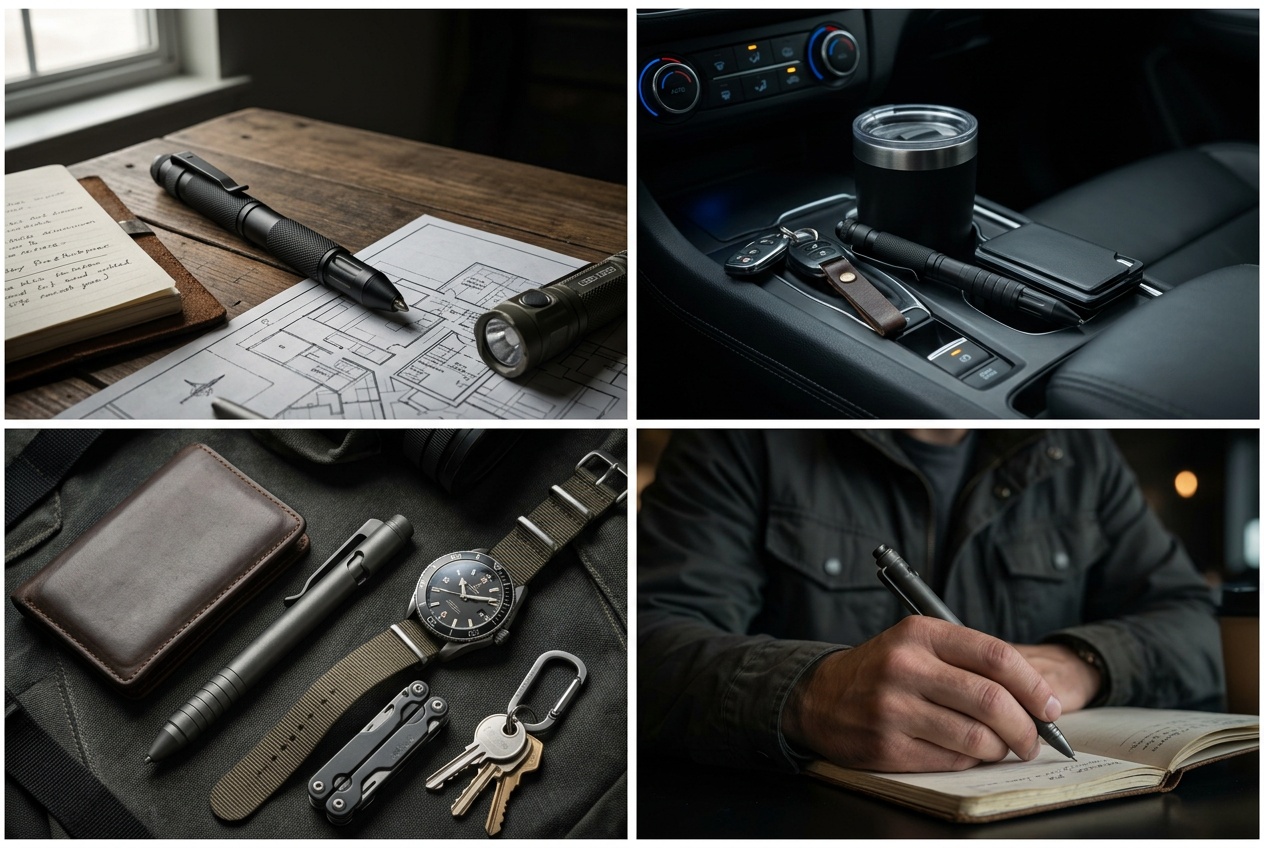
A tactical pen is one of the few self-defense tools that blends into everyday carry without changing how you dress, how you travel, or how you move through public space. It clips to a shirt pocket. It signs receipts. It writes in a notebook. And if a parking structure or a back alley turns into the wrong situation, the same metal pen body becomes a real personal protection tool. This guide is written from a gray man and OSINT-aware perspective. Living abroad and crossing borders teaches you that situational awareness beats hardware almost every time, and that the best gear is the kind that disappears into daily life. Read on for what tactical pens actually do, which ones are worth carrying, and how a smart EDC pen fits modern urban travel.
What is the point of a tactical pen?
The point of a tactical pen is straightforward. It is a writing tool that doubles as a last-resort defensive tool when nothing else is on you. Most are made of metal, usually aircraft aluminum or stainless steel, with a reinforced glass breaker tip. They write like a regular pen. They can also be used as a weapon if a situation goes sideways and you have run out of distance to create.
For someone with a civilian operator mindset, that dual purpose is the whole point. A pen comes with you everywhere. Through airports. Through hotel lobbies. Through dinner meetings. Through gas stations at midnight. A firearm cannot do that in most countries and many U.S. cities. Pepper spray is restricted in plenty of places. A tactical pen gives you a quiet personal security layer without changing the shape of your jacket. Ordinary object, extraordinary utility.
Why does a tactical pen fit a gray man EDC?
Gray man carry is about not standing out. The wrong watch, the wrong jacket, the wrong shoes can all turn you into a soft target in a non-permissive environment. A tactical pen is the opposite of an aggressive-looking knife or a bulky flashlight on your hip. It looks like an office tool. It reads as a writing pen, not as a weapon. That low-signature appearance is exactly why it works as discreet self-defense.
The other half of gray man EDC is mobility. You want gear that moves with you and never slows you down. A pen weighs almost nothing. It clips inside a jacket without printing. It clears any pat-down or bag check that allows pens at all. For travelers, expats, and security-conscious professionals who move through transitional spaces every day, that combination is hard to beat.
What separates a tactical pen from a regular pen?
A regular pen is plastic. It bends. It snaps. It will not deliver impact force when you need it. A tactical pen is built around that exact requirement. The pen body is usually a solid bar of metal, often matte black, with a textured grip that holds in sweat or rain. Most include a tungsten or steel glass breaker tip. Some add a hex key, a stylus, or an LED flashlight. A few function as a small multitool. There is also a Glock pen on the market, branded by the firearm maker, for fans who want a coordinated EDC kit.
The internals matter just as much. Cheap pens use whatever ink cartridge fits. A serious tactical pen ships with quality pen refills like the Schmidt EasyFlow 9000 or a Fisher Space Pen pressurized cartridge. That matters in harsh conditions. A pressurized refill writes upside down, in extreme cold, on greasy paper, even underwater. Pair black ink with Rite in the Rain stock and you have a writing pen that performs when standard gear fails.
What is a Tactical Spy Pen?
A tactical spy pen takes the same self-defense concept and dials the styling all the way down. The metal body is still there. The glass breaker is still there. What changes is the appearance and sometimes the feature set. A tactical spy pen is slimmer, plainer, and harder to clock as a defensive tool. Some versions add a hidden voice recorder or a small camera. Others rely purely on stealth and look like an ordinary office pen.
For OSINT-minded carry and gray man EDC, that distinction is useful. A pen that looks aggressive can draw attention in the wrong setting, especially during international travel or at meetings where weapons clearly do not belong. A spy pen blends in. You can clip one to a dress shirt at a cafe in Mexico City, slide it into a notebook on a flight to Bogota, or hand it to someone to sign a form without anyone reading it as anything but stationery. If you opt for a model with audio recording, know your local laws first. Many places require two-party consent for audio.
Is it legal to carry a tactical pen?
In most of the United States, yes, it is legal to carry a tactical pen. It is a pen. Federal law does not regulate writing instruments. Most states do not either. You can usually carry one in your pocket, briefcase, or laptop bag the same way you would carry any other ballpoint pen. That is one of the main reasons people pick a metal pen for covert self-defense.
Intent and location still matter. A pen used as a weapon can fall under assault statutes the same way a baseball bat or a flashlight can. Courthouses, federal buildings, and certain schools restrict any item that could cause harm. International rules vary too. Countries that use the spelling self-defence, like the UK and Australia, take a stricter view on impact tools. If you travel internationally, learn the local rules before you cross. The smart move is responsible carry. Treat it as a tool, not a toy.
Does TSA allow tactical pens?
This is the question I get the most, and my honest answer is that I have never had TSA even question my tactical pen. I cross the U.S. and Mexico border constantly, and I have never had an issue with customs or airport security on either side. That is not a guarantee it will never happen. Policies vary by agent, by airport, and by the way your bag scans. What you definitely should not do is pack twelve of them in your carry-on. That will absolutely look suspicious and turn a quick check into a long conversation.
If you want zero hassle, put your dedicated tactical pen in checked luggage. Carry a Fisher Space Pen or a slimmer writing tool in your laptop bag for the flight itself. That keeps a useful pen with you in the cabin without giving any agent a reason to second-guess what they are looking at. Plan around the lowest-friction outcome and your gear will move with you, not against you.
How do you use a tactical pen for self-defense?
You use a tactical pen the same way you would use a kubaton. Grip it like an ice pick or in a hammerfist position, with the tip out and your thumb capping the back end. Hit soft targets. The throat. The eyes. The side of the neck. The inside of the thigh. The back of the hand. Short, sharp strikes. Then create distance and move. The goal is not to win a fight. The goal is to break contact so you can get to a vehicle, a populated area, or help.
This is why training matters. A tactical pen for self defense is only as good as the person holding it. The pen by Doug Marcaida from Forged in Fire, the CRKT Williams Defense Pen designed by martial arts instructor and former Army officer James Williams, and similar tools were created by people who actually train with them. You do not need to be Jason Bourne to use one well. You need a couple of practiced grips, a few rehearsed strikes, and the awareness to see the threat early enough to draw the pen at all.
What is the best rated tactical pen?
The best rated tactical pen depends on what you actually need. If you want the most popular EDC pen with broad user feedback, the Atomic Bear tactical pen, sold as the Stealth Pen Pro, is hard to beat for the price. It uses an aircraft aluminum body, an LED flashlight, a tungsten tip glass breaker, and a textured Beargrip surface. The Atomic Bear sits at the top of most independent reviews because it gets the basics right and skips the fluff.
For better build quality, the CRKT Williams uses 6061 aircraft-grade aluminum, a Type III black hard-anodized finish, and a Fisher Space Pen ink cartridge that delivers smooth writing in any temperature. The Gerber Impromptu is another reliable tool with a tungsten carbide glass breaker, 304 stainless steel construction, and a bolt-action mechanism. For something exotic, look at a Guardian Titanium or a limited production tungsten model. They cost more, but they last forever.
Best tactical pens for urban EDC and travel
Here is a short list of best tactical pens that have proven themselves in real use. These are the names that show up again and again in EDC threads, instructor recommendations, and traveler forums.
- Atomic Bear Stealth Pen Pro: Aircraft aluminum body, LED flashlight, tungsten glass breaker, textured Beargrip. The default first tactical pen for most people.
- CRKT Williams Defense Pen: Designed by James Williams, former Army officer and martial arts instructor. Real tactical applications. Pressurized Fisher cartridge writes in any condition.
- Gerber Impromptu: 304 stainless steel, tungsten carbide glass breaker tip, bolt-action deployment, weapons-grade build. A workhorse for everyday use.
- Fisher Space Pen Bullet (Military): Not a glass-breaking model, but the toughest writing pen ever made. Pressurized ink refills. Writes anywhere.
- Smith & Wesson Tactical Pen: Aircraft aluminum, matte black, glass breaker tip, classic clicker top. Budget friendly and easy to carry.
- Voodoo Tactical Master Pen MTP-6: Heavier and more aggressive, with a serious glass breaker. Built for harsh conditions and field use.
- Glock Tactical Pen: A coordinated option for Glock fans. Solid metal pen with a clean, no-nonsense design.
- Warrior Poet Supply Co WPS Tactical Pen: Reliable tool with a refillable black ballpoint and good compatibility across common refill sizes.
- Pen by Doug Marcaida: Designed for impact and martial arts use by someone who actually fights with these tools.
What features actually matter on a tactical pen?
Skip the gimmicks. A tactical pen needs four things. A strong pen body in aircraft aluminum, machined steel, or titanium. A reliable steel glass breaker tip in tungsten or hardened steel for emergency glass breaker use. A good ink cartridge with refill compatibility, ideally a medium black Schmidt or a pressurized Fisher unit. And a textured grip with enough texture to keep your hand locked in under sweat.
Everything else is bonus. A built-in stylus is handy if you live on your phone. An LED flashlight adds value if you are not already carrying one. A magnetic mount on the cap is useful for sticking the pen to a metal surface in a vehicle. Some pens transform into a trainer with a swap of the cap, which is great for safe practice. A multitool layout with a hex key adds utility. Get the basics right first.
How do you train with a tactical pen?
Owning a tactical pen is the easy part. Knowing how to use a tactical pen under pressure is what most people skip. Set aside thirty minutes a week. Practice drawing the pen from your pocket. Practice the grip. Run through three or four basic strikes on a heavy bag or a hanging towel. Many manufacturers sell a trainer version of the same pen body, and some pens transforms into a trainer with a quick swap of the cap. Use it.
Build the awareness layer too. A tactical pen does you no good if you never see the threat coming. Eyes up in parking structures. Scan gas stations. Trust your gut when transitional spaces feel wrong. The pen is a last-resort defensive tool, not a first option, and it is meant for self-defense or emergency use, not picking fights. Force avoidance comes first. The pen is what you reach for when avoidance has already failed.
Final Thoughts on Carrying a Tactical Pen
A tactical pen is not magic. It will not stop a determined attacker by itself. What it will do is give you a quiet personal protection layer that comes with you through airports, hotel lobbies, taxi rides, and walks back to your car at night. For a security-conscious traveler or anyone who lives in a high-friction urban environment, that quiet utility is exactly the point.
Things to remember:
- A tactical pen is a writing pen and a low-profile self-defense tool in one body.
- A tactical spy pen is the same idea with covert styling and sometimes a hidden recorder.
- Look for aircraft aluminum, stainless steel, or titanium with a tungsten or steel glass breaker tip.
- Quality refills like the Schmidt EasyFlow 9000 or a Fisher Space Pen cartridge keep it useful for daily writing.
- Carry is legal in most U.S. locations, but check local rules before international travel.
- TSA enforcement is inconsistent. Pack smart and do not travel with a dozen pens in your carry-on.
- The Atomic Bear Stealth Pen Pro, CRKT Williams, and Gerber Impromptu are top picks across price tiers.
- Train with it. A tactical pen for self defense only works if your hand already knows the grip.
- Situational awareness beats any tool. Carry a pen anyway.
- Stay alert. Stay mobile. Carry what you can actually use.
About the Author