Combat Optics and the Modern Gunfight
A gunfight is a problem of time. The shooter who identifies the threat, acquires the target, and places accurate shots first is the shooter who walks away. Everything else is a footnote.
Your optic is the single biggest variable in that equation after training. The right sighting system compresses your timeline. The wrong one stretches it. And stretched timelines in a gunfight get people killed.
This is not a product roundup. This is a breakdown of what combat optics actually need to do when rounds go downrange, organized by the conditions that matter: distance, stress, light, and failure modes.
What Separates a Combat Optic from a Range Toy
The optics industry throws the word “combat” on everything. Matte black finish. Aggressive font on the box. Suddenly it’s “combat-rated.” That label means nothing without the performance to back it.
A real combat optic has to clear four gates:
- Speed. It must deliver faster target acquisition than iron sights. If it doesn’t, it’s dead weight on your rail.
- Durability. Not lab durability. Field durability. The kind that holds zero after the rifle gets dropped on asphalt, slammed into a truck bed, or dragged through a doorway under fire.
- Lighting versatility. Gunfights happen at 2 AM in parking lots and at noon in open fields. The optic needs to work across all of it.
- Simplicity under stress. If it requires fine motor adjustments to function, it will fail you when your hands are shaking and your heart rate is north of 170 BPM.
The optics carried by special forces units and infantry tend to share these traits. Simple reticles. Forgiving eye relief. Rugged housing. Battery life measured in years or no battery dependency at all.
That’s the filter. Everything below runs through it.
Engagement Distance: The Decision That Drives Everything
Pick the wrong optic for your engagement distance and nothing else saves you. Not the brand. Not the price tag. Not the reticle pattern. Distance dictates the entire selection.
Close Range: Contact to 25 Yards
This is CQB distance. Hallways. Doorways. Parking lots. The space between your front porch and the street.
Inside 25 yards, speed wins. Magnification is a liability. What you need is a wide field of view, both-eyes-open shooting, and a reticle that puts you on target the instant the optic meets your eye line.
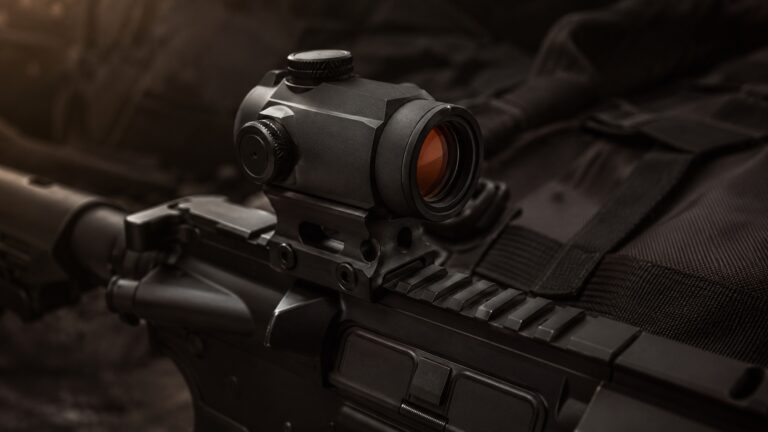
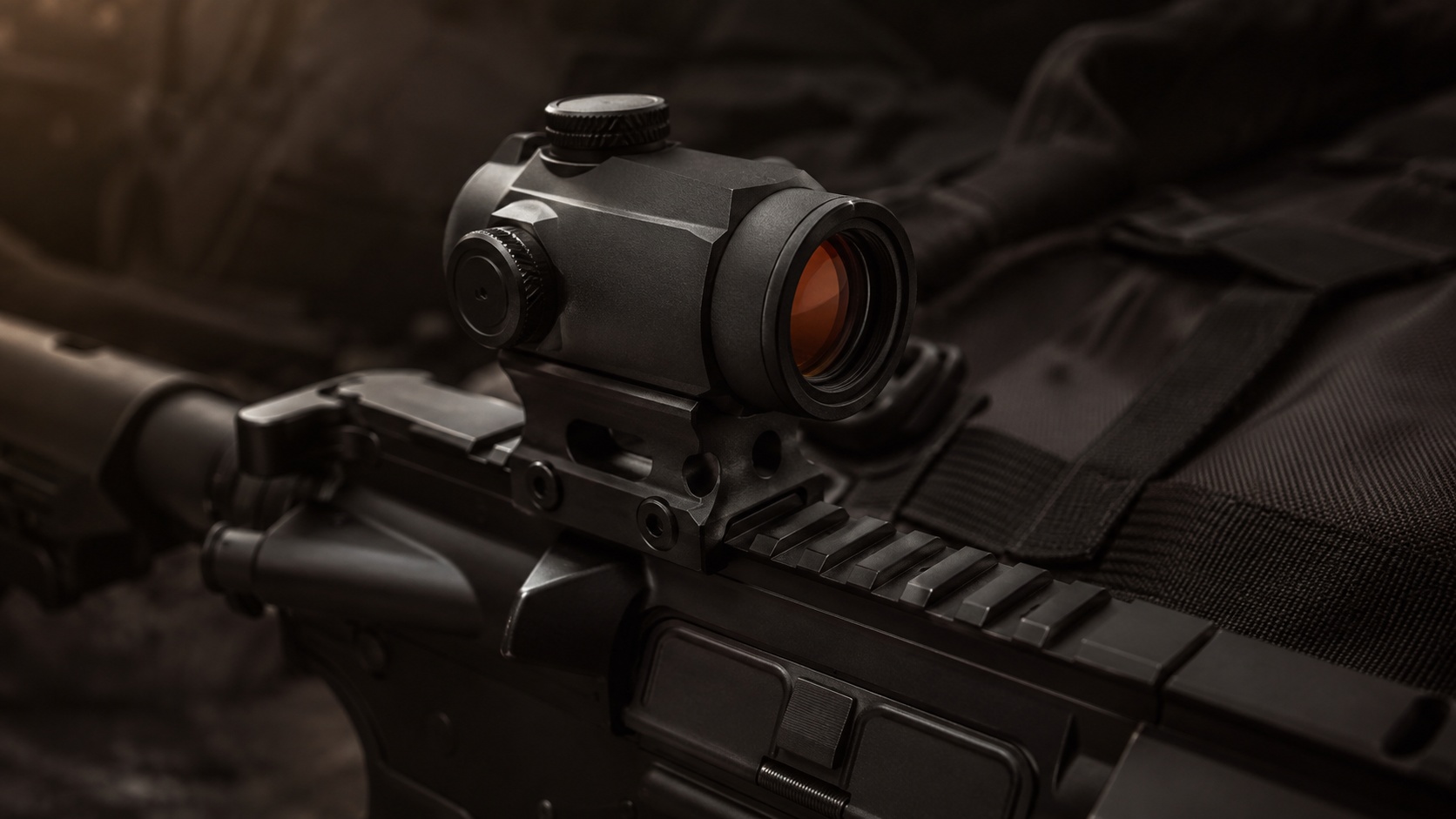
Red dot sights own this bracket. A reflex sight running at 1x with a simple dot reticle gives you the fastest target acquisition available on a firearm. No scope shadow. No parallax at realistic distances. You keep both eyes open, you see the dot on the threat, you press.
The Aimpoint CompM series set the standard. The T-2 and its predecessors have logged more combat time than any other red dot in existence. The Trijicon MRO and EOTech holographic sights fill the same role with different optical approaches. EOTech’s wider window gives some shooters faster target transitions during dynamic shooting scenarios. For pistol-mounted red dot sights, the Trijicon RMR proved that a reflex sight on a handgun is a genuine force multiplier in close-range engagements.
Budget-conscious shooters shouldn’t dismiss newer entries. Optics like the MCG Tactical Stinger combat optic have closed the performance gap, delivering combat-relevant speed and durability at a fraction of what legacy brands charge. The real test isn’t the logo. It’s whether the optic holds zero through a thousand rounds and survives a drop onto concrete.
Mid-Range: 25 to 200 Yards
Mid-range forces a tradeoff between speed and precision. At 25 yards, a rough sight picture works. At 150, shot placement separates hits from misses. You need to identify what you’re shooting at and put the round exactly where it needs to go.
Two optic categories own this bracket: LPVOs and prism scopes.
Low-power variable optics (LPVOs) in 1-6x or 1-8x give you genuine versatility. At 1x, the LPVO functions as an oversized red dot for close-range work. Crank it to 6x and you can engage targets at 200 yards with enough magnification for positive target identification. The tradeoff is weight, complexity, and a narrower field of view at higher magnification.
The LPVO has become the default combat rifle optic for good reason. The Vortex Razor HD Gen III, the Trijicon VCOG, and the Sig Sauer TANGO series all deliver combat-grade optical clarity with illuminated reticles that perform across lighting conditions. The U.S. military’s adoption of the 1-8x LPVO as the Squad Common Optic tells you where the institutional thinking landed.
Prism scopes sacrifice variable zoom for simplicity and reliability. The Trijicon ACOG at 4x is the most famous example. Fixed magnification. Etched reticle that works without batteries. The ACOG earned its reputation as the USMC Rifle Combat Optic across two decades of deployments. The etched glass reticle never goes dark, even with a dead fiber optic element. For shooters who know their engagement distances will fall in a predictable band, a prism scope remains one of the most reliable combat optics available.
| Optic Type | Best Range | Speed | Weight | Battery Dependent | Versatility |
|---|---|---|---|---|---|
| Red dot / reflex | 0-50 yds | Fastest | Lightest | Yes (long life) | Low |
| Prism scope (3-4x) | 50-300 yds | Moderate | Light | No (etched reticle) | Low |
| LPVO (1-6x / 1-8x) | 0-200 yds | Fast at 1x | Heaviest | Yes (illumination) | Highest |
Extended Range: Beyond 200 Yards
Past 200 yards, you need real magnification. Bullet drop, wind drift, and target identification all demand more from the optic. Dedicated riflescopes with 6x, 10x, or higher magnification take over.
The reticle design becomes critical here. You need holdover references: BDC hash marks, mil-dot patterns, or a calibrated Christmas tree reticle that lets you compensate for bullet drop without dialing turrets. A first focal plane (FFP) reticle keeps those references accurate across the entire magnification range. A second focal plane (SFP) reticle is only accurate at one setting. In a gunfight, you will not remember which one.
FFP riflescopes from Nightforce, Vortex, and Sig Sauer dominate the precision rifle space for exactly this reason. The math works at every zoom level. For long-range shots past 300 yards, that consistency matters more than any other feature on the scope.
Here’s the honest truth: most civilian defensive scenarios will never happen at these distances. If you’re setting up a rifle for home defense or property security, the money you’d spend on a 5-25x scope is almost certainly better allocated to a quality LPVO or red dot plus a case of training ammunition.
What Stress Does to Your Shooting
Gear reviews skip this. It’s the factor that matters most.
When your heart rate spikes past 170 BPM and adrenaline floods your system, three things happen that directly affect how you use an optic.
Fine motor control disappears. Dialing magnification, flipping a throw lever, adjusting a turret: all of these require fine motor skills that evaporate under stress. An optic you can run without touching anything after it’s mounted and zeroed is worth more in a fight than one with ten times the features.
Tunnel vision collapses your awareness. A large objective lens and wide viewing window help offset this, but training is the real counter. Shooting with both eyes open is not optional in a gunfight. It’s how you maintain situational awareness while engaging a threat. Red dot and reflex sights support eyes-open shooting by design. Magnified scopes and riflescopes make it harder. That’s one reason the LPVO at 1x is such a useful starting point for a defensive rifle.
Target transitions slow down. Moving from one threat to another exposes optic weaknesses that never show up on a bench rest. Poor eye relief punishes you every time you break cheek weld and reacquire. A heavy riflescope with a tall mount shifts the rifle’s balance and slows every transition. The shooters who move fastest between targets in competition and real engagements are almost always running the lightest, simplest optic the mission allows.
The practical lesson: train with the optic you’d fight with. Run it under stress. Timed drills. Elevated heart rate. Low light. Awkward positions. If it’s too complicated when you’re gassed, it’s too complicated for a fight.
Light Conditions and Combat Optic Performance
Lighting is the variable most shooters underestimate. A sight picture that’s perfect at noon on a clear range can become useless at dusk, under sodium-vapor parking lot lights, or during a transition from a bright exterior into a dark interior.
Illuminated Reticles
A red or green illuminated dot or crosshair gives you a visible aiming point in low-light conditions where an unlit black reticle would vanish against a dark background. But illumination creates its own problems. Too bright and it blooms, washing out the target. Too dim and you lose it against a bright background.
The best combat optics offer wide illumination ranges with enough granularity to dial in exact brightness for the specific conditions you’re in.
Etched Reticle Failsafe
Etched reticle designs found in prism scopes and many LPVOs give you a backup plan. With the illumination off, the reticle is physically etched into the glass and stays visible through ambient light contrast alone. This is one of the Trijicon ACOG’s most important features and a big part of why it remains relevant decades after introduction. No battery, no fiber optic, no problem. You still have a functional reticle.
Lens Coatings
Multi-coated lenses improve light transmission significantly. That translates to a brighter, clearer image in exactly the conditions where you need it most: dusk, dawn, interior spaces, overcast days. Cheap lenses with poor coatings cost you usable minutes of visibility at both ends of the day. In a defensive scenario, those minutes could be the ones that matter.
Night Vision Compatibility
Optics designed to work with night vision devices require specific brightness settings that won’t bloom or flare through an image intensifier. If NV is part of your capability set, the optic must explicitly support it. Not all do.
What Fails First
Every optic is a mechanical and optical system with failure points. Knowing what breaks first helps you choose gear that’s harder to kill.
| Failure Mode | Risk Level | Mitigation |
|---|---|---|
| Battery dies | Highest | Choose optics with 50,000+ hour battery life or battery-free etched reticles |
| Zero drift from mount | High | Quality mount base, Loctite, torque to spec, confirm zero regularly |
| Lens damage | Moderate | Lens covers, kill-flash devices (tradeoff: adds bulk) |
| Electronics failure | Moderate | Simpler designs fail less; avoid unnecessary electronic features |
Batteries are the most common failure. Aimpoint addressed this by engineering battery life measured in years of continuous use. The CompM5 runs roughly five years on a single AAA. The Trijicon ACOG eliminated the issue entirely with tritium and fiber optic illumination. Any combat optic worth carrying should have battery life measured in thousands of hours or no battery dependency at all.
Zero retention is the second most common failure. The optic shifts on the mount base, or internal adjustments drift under recoil. A $2,000 riflescope on a $30 mount is a $30 system. Quality mounting hardware matters as much as the optic itself.
Electronics can fail in ways a simple red dot or etched reticle never will. Heat, cold, water intrusion, and shock can all kill electronic components. EOTech addressed their cold-weather zero shift issues years ago, but the principle holds: more electronics means more failure modes.
The optics that survive the most abuse tend to be the simplest. There’s a reason the Aimpoint T-2 and the Trijicon ACOG keep showing up on rifles carried by people who actually get shot at.
Combat-Proven vs. “Combat” Marketing
There’s a real difference between optics carried into combat by military and law enforcement units and optics that borrow the word for branding purposes.
The genuinely combat-proven list is short:
- Trijicon ACOG: Standard-issue USMC Rifle Combat Optic since the early 2000s
- Aimpoint CompM series: U.S. Army’s M68 close combat optic for over two decades
- EOTech holographic sights: Carried by special forces and SWAT teams worldwide
- Elcan SpecterDR: Adopted by multiple NATO militaries
- Vortex Razor series: Adopted across several U.S. military programs
That does not mean less-known optics can’t perform. The market has improved dramatically in the last decade. Several newer manufacturers produce optics that meet or exceed the mechanical and optical standards set by legacy brands at significantly lower price points.
The MCG Tactical Stinger is a good example. Purpose-built for rapid target acquisition at CQB distances. Built to handle hard use. Priced for shooters who want combat-relevant performance without the legacy brand markup.
The test is not the brand name. The test is whether the optic holds zero, survives abuse, delivers a clear sight picture across lighting conditions, and lets you put rounds on target faster than iron sights alone. Any optic that passes those four gates is combat-worthy.
Matching the Optic to the Fight
There’s no single optic that covers every shooting scenario. The right choice depends on the engagement you’re most likely to face.
- Home defense: Red dot or reflex sight. Speed is the priority. Engagements are measured in feet. An illuminated red dot at 1x with both-eyes-open shooting gives you the fastest time from shouldering the rifle to rounds on target.
- Property and rural defense: LPVO in 1-6x or 1-8x. You need the versatility to engage at close range and still reach 200 yards if the situation demands it.
- Designated marksman / overwatch: Magnified riflescope with FFP reticle. Past 200 yards, you need magnification for target identification and reticle precision for accurate holdovers. A 3-18x or 4-16x scope with mil-dot or MOA hash marks covers it.
- Pistol: Micro reflex sight on the RMR footprint. A slide-mounted red dot gives you faster target acquisition than iron sights alone. The learning curve is real. Budget time for training.
The Hard Baseline
Whatever optic you choose, the glass is only as good as the shooter behind it. A thousand dollars of optic on a rifle you haven’t trained with is a thousand dollars wasted.
Buy the best combat optic you can afford for your most likely engagement scenario. Mount it properly. Zero it. Then put rounds through it until using it is as reflexive as pointing your finger.
Speed. Accuracy. Reliability. Those three things win gunfights. Your optic either serves them or it doesn’t. Choose accordingly.
About the Author