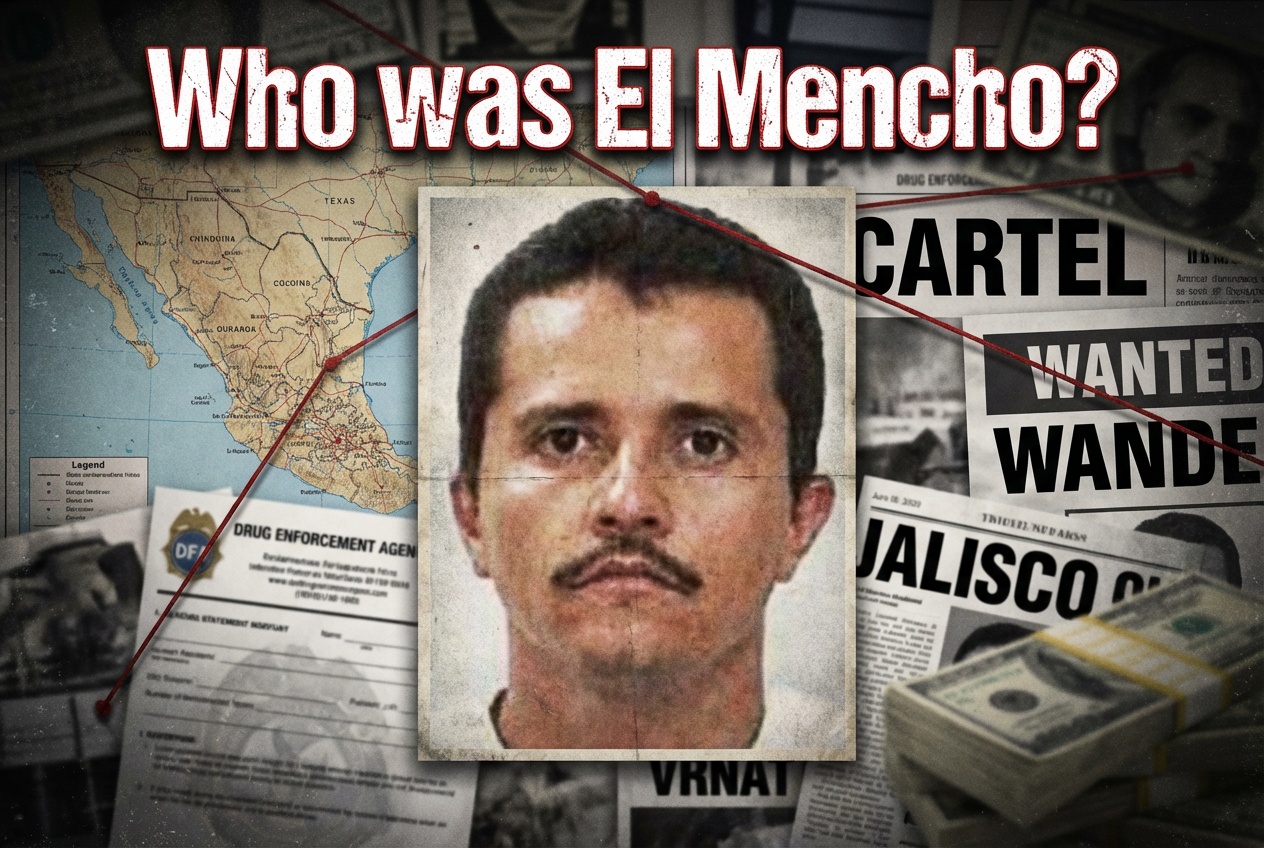
Who Was El Mencho? Is El Mencho Alive? The Rise and Death of CJNG Leader
TL;DR: “El Mencho” was the leader and founder of the Jalisco New Generation Cartel (CJNG), one of Mexico’s most powerful and violent criminal enterprises, and arguably its most powerful cartel. Born under the name, Nemesio Oseguera Cervantes, he was killed in February 2026 during a raid by the Mexican military in the city of Tapalpa (Jalisco). His death was followed by widespread violence and terror throughout the country and is regarded by some as the largest setback for organized crime in Mexico since the capture of El Chapo (Joaquín Guzmán Loera).
For years, the name ‘El Mencho’ carried more weight in Mexico’s underworld than almost any other. He was Mexico’s most wanted man — a ghost-like figure with a $15 million U.S. bounty on his head. Almost no recent photographs of him existed. He ran a billion-dollar empire from the mountains of Jalisco, and his organization waged open war against rivals and the Mexican government alike.
Now he’s dead. And the aftermath has been staggering. This article covers who he was, how he rose from poverty to lead one of the most dangerous organizations on the planet, and what his death means for Mexico.
Who Was the Man Behind the Name Oseguera Cervantes?
Oseguera was born on July 17, 1966 in a rural community near Aguililla, in the state of Michoacán. He grew up poor. His family cultivated avocados, and he dropped out of primary school in fifth grade to work in the fields. By age 14, he was guarding marijuana plantations.
In the 1980s, the young man crossed illegally into California, hoping for a better life. He ended up in the San Francisco Bay Area, where he was arrested for stolen property and carrying a loaded gun at 19. Over the next several years, he was caught multiple times for narcotics offenses. In 1992, he and his brother Abraham were snared in a federal heroin sting in Sacramento. He took a guilty plea to protect his brother from life in prison and served time at a federal facility in Texas.
After his release, he was deported to Mexico at age 30. He briefly joined local police forces in Jalisco before leaving law enforcement to join organized crime full-time. That decision would reshape the Mexican drug landscape for decades.
What Does “El Mencho” Mean in Spanish?
The nickname is a phonetic derivation of his given first name. In parts of western Mexico, it’s a common informal shortening — similar to how “Nacho” comes from “Ignacio.” It doesn’t carry independent meaning in Spanish. It’s simply a name. But it became one of the most feared aliases in the history of organized crime.
Oseguera was also known as “The Lord of the Roosters,” reportedly because of his love for cockfighting. But it was the alias that law enforcement, intelligence agencies, and rival groups all learned to associate with extreme violence and ruthless efficiency.
How Did El Mencho Build the CJNG?
After returning to Mexico, Oseguera worked for the Milenio Cartel, a drug trafficking organization controlled by the Valencia family in Jalisco. He married Rosalinda González Valencia — the sister of one of the clan’s leaders — which cemented his position within the group. He started as a bodyguard and hitman but rose fast through the ranks.
When the Milenio Cartel split into two factions around 2009 — partly due to internal power struggles and pressure from rival groups like Los Zetas — Oseguera emerged as the breakaway leader. That new organization became the Cartel Jalisco Nueva Generacion, known by its Spanish name as the Cartel de Jalisco Nueva Generación, or the CJNG. The cartel formed in the state of Jalisco and quickly established itself as a major force. The cartel began pushing into rival territory almost immediately. It’s sometimes written as Cartel – New Generation in English-language sources.
Under his leadership, the organization began expanding aggressively. It pushed into territory held by the Sinaloa Cartel, Los Zetas, and smaller criminal groups in Mexico. Within a few years, the group had become the most powerful drug cartel in the country, according to both the FBI and the DEA. He was the undisputed Jalisco New Generation Cartel leader — feared by allies and enemies alike.
What Made This Jalisco Cartel So Dangerous?
The organization wasn’t just another trafficking operation. It functioned more like an insurgent army. Members used military-grade weapons, armored vehicles, armed drones, and improvised explosive devices. They launched direct assaults on the Mexican army — something few other groups dared to do.
They moved cocaine, heroin, methamphetamine, and fentanyl into the United States on a massive scale. They also ran human smuggling and extortion rackets across Jalisco and neighboring states. Their reach extended into Europe, Asia, and Africa.
His organization — and the related Los Cuinis drug trafficking organization run by his in-laws — were also known for brutality. Public displays of violence became a trademark. The group used terror as a deliberate strategy to control populations, silence opposition, and intimidate law enforcement.
Was El Mencho Mexico’s Most Wanted Drug Lord?
Absolutely. For years, Rubén Oseguera Cervantes sat at the top of both Mexico’s and America’s most-wanted lists. The United States Department of State, through its Narcotics Rewards Program, offered up to $15 million for information leading to his arrest — one of the largest bounties ever placed on a wanted drug kingpin. The Department of State listing described him as the leader of the Jalisco New group. The Mexican government offered an additional 300 million pesos.
He was wanted on federal charges in the District of Columbia and other U.S. jurisdictions for conspiracy, trafficking, and other offenses. Despite the enormous resources devoted to finding him, he remained elusive. He hid in rugged mountain terrain, surrounded by mercenaries with former military training. Almost all known photographs were decades old. He cultivated mystery, rarely communicating even with his own people directly.
His status as a wanted cartel boss made him the most significant target for both Mexican authorities and the DEA since Joaquin “El Chapo” Guzman.
What Happened to El Mencho in Mexico?
On a Sunday morning in late February, security forces killed Oseguera Cervantes during a military operation in the mountain town of Tapalpa, approximately 130 kilometers southwest of Guadalajara.
The operation was triggered by intelligence from an associate of one of his romantic partners, according to multiple reports. Authorities began surrounding the area two days prior. By predawn on the day of the raid, special forces backed by the National Guard, aircraft, and helicopters moved in.
Gunmen opened fire as soldiers advanced. A fierce firefight erupted. Several fighters were killed at the scene. Oseguera and his inner circle fled to a nearby wooded cabin complex, where a second clash broke out. Soldiers eventually found a wounded Oseguera alongside bodyguards. He was airlifted toward Mexico City for medical treatment but died during the flight.
CBS News and other outlets reported that the raid relied on a combination of domestic capabilities and U.S. intelligence support. The Mexican military operation was the culmination of years of effort by both nations — and the most significant action against organized crime in Mexico since the recapture of Guzman nearly a decade ago.
What Happened After the Cartel Leader’s Death?
The death of the cartel chief set off an immediate and violent response. Within hours, chaos spread across multiple Mexican states.
The defense ministry identified a senior CJNG figure known as “El Tuli” — the fallen leader’s right-hand man — as the organizer of coordinated retaliatory attacks. He reportedly offered bounties of 20,000 pesos for each soldier killed. Later that same day, Mexican security forces tracked him to El Grullo, a small town southwest of Guadalajara, and killed him in a clash.
Cartel members torched vehicles, blocked highways, and attacked government buildings across more than 20 states. In Puerto Vallarta, a popular Pacific resort in Jalisco state, a Costco was set ablaze. Airlines canceled flights. Schools suspended classes in at least 13 states. Guadalajara — set to host FIFA World Cup matches in 2026 — turned into a ghost town as residents sheltered indoors.
By Monday, the death toll had reached at least 30 suspected gang members, 25 National Guard troops, and one civilian. More than 70 people were arrested. It was the worst spasm of narco-violence Mexico had seen in years.
What Are Mexican Cartels Fighting For?
These organizations are fighting for control of smuggling routes into the United States — the world’s largest consumer market for illegal narcotics. The stakes are enormous. The trade generates tens of billions of dollars annually, and controlling territory means controlling the northward flow of product.
But it goes beyond drugs. Modern groups also profit from human smuggling, extortion, illegal mining, oil theft, and arms trade. They fight each other for turf, and they fight the state for impunity. Control over local governments, police forces, and transportation corridors is critical to their operations.
The current leader of the cartel — whoever ultimately consolidates power after El Mencho’s death — will inherit an organization that generates billions but faces extreme internal pressure. History shows that when a cartel leader falls, fragmentation follows. Lieutenants jockey for control, splinter factions emerge, and violence often escalates before it stabilizes.
Is El Mencho Alive?
No. He is dead. The death of Nemesio was confirmed after the operation in Tapalpa. Mexican President Claudia Sheinbaum addressed the nation, calling for calm and confirming coordination across all states. His body was later returned to his family.
There had been false reports of his death before — including unconfirmed rumors in 2022 that he died from respiratory arrest in a private hospital in Guadalajara. Those reports were denied by DEA officials. But the 2026 operation and subsequent government confirmation leave no doubt. The cartel leader Nemesio — the man who had eluded capture for over a decade — is gone.
The Shadow That Changed Mexico
His story is, in many ways, the story of Mexico’s struggle with organized crime itself. He was born into poverty in a Mexican state torn by violence, crossed borders, served time in American prisons, returned home, and built one of the most feared empires in modern history. Under his command, a regional splinter group became a global powerhouse trafficking fentanyl, meth, and heroin across continents.
His death removes one of the most significant figures in the Western Hemisphere’s criminal landscape. But it doesn’t end the crisis. As analysts have noted, the “kingpin strategy” of targeting leadership has a mixed track record. The Sinaloa organization fractured but survived after its leader’s capture. The same pattern may repeat.
What’s different this time is the context. The Sheinbaum administration has signaled willingness to use direct force — a departure from her predecessor’s “hugs, not bullets” approach. U.S.-Mexico intelligence cooperation is deeper than it has been in years. Whether that translates into lasting improvement remains the open question.
Here’s what to remember:
- El Mencho — also known as “El Mencho” — was the leader of the CJNG, one of the most powerful organizations in Mexico.
- He was killed on February 22, 2026 during an operation in Tapalpa, supported by U.S. intelligence.
- The organization is responsible for moving massive quantities of fentanyl, cocaine, meth, and heroin into the U.S.
- His death triggered a wave of violence with roadblocks, arson, and attacks in more than 20 states.
- “El Mencho” is a phonetic nickname derived from his first name — not a standalone Spanish word.
- The organization formed around 2009 after his former group fractured, with him taking control of the breakaway faction.
- He was Mexico’s most wanted with combined bounties exceeding $30 million across both countries.
- His killing is the most significant blow against organized crime since the capture of El Chapo.
- The future of the CJNG — and whether this death reduces or escalates violence — remains uncertain.
About the Author