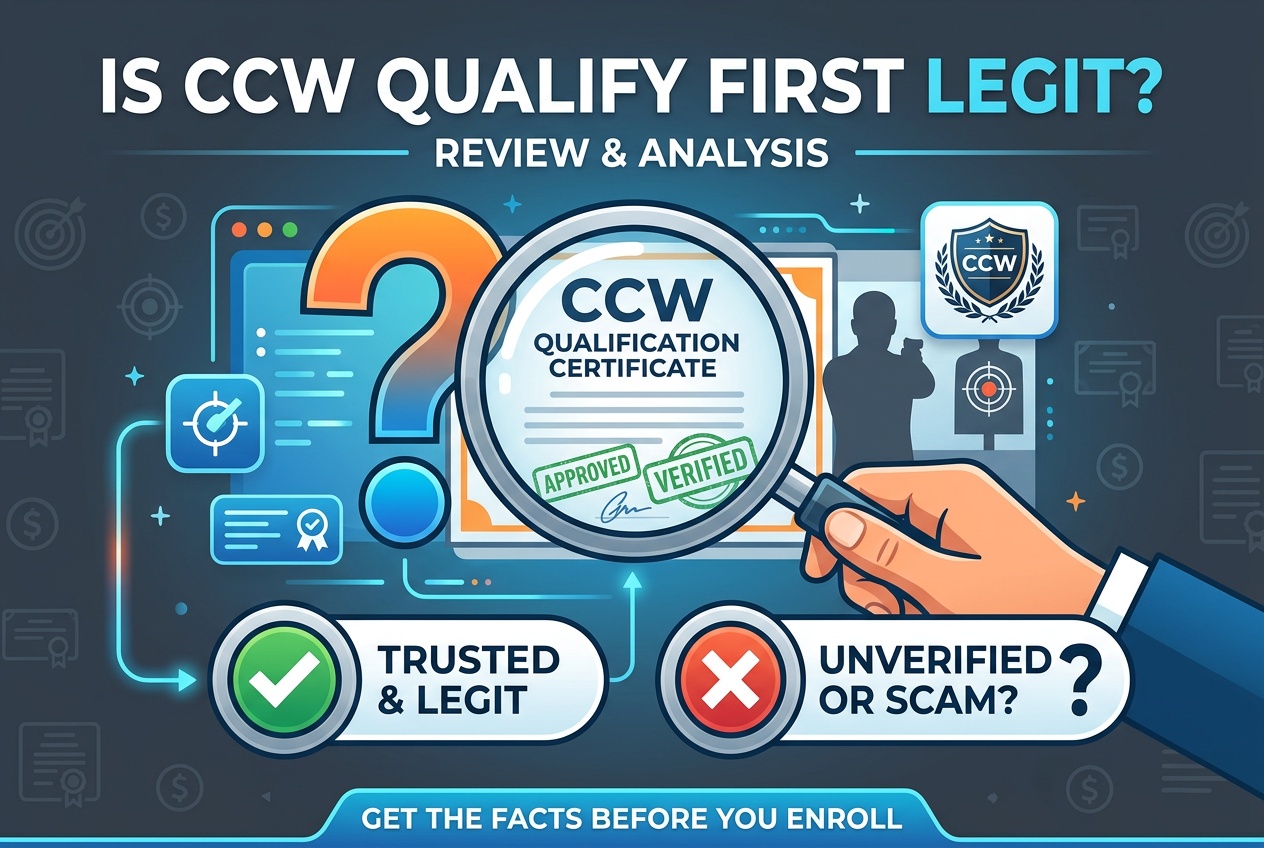
The Drop: CCW Qualify First is a real, functioning website that sells an online course and helps you apply for a New Hampshire non-resident concealed handgun permit. It’s not a vanishing checkout scam, but it’s not the magic bullet the ads make it sound like either. The course is a 30-minute video and a 10-question quiz, the no-refund policy is strict, and the New Hampshire permit it helps you get won’t let you legally carry in California, New York, New Jersey, Maryland, Illinois, or Hawaii. Trust scores on ccwqualifyfirst.com are low, and similar online CCW services have been hammered by the Better Business Bureau. If you live in a strict state, skip it. Apply through your home state, take a real in-person safety course with an NRA certified instructor, get live-fire range time, and verify reciprocity laws before you spend a dime.
You saw the ad. Probably on Facebook or Instagram. “Carry concealed in 30 minutes.” No range time required. No government agency visits. Just a quick online course, a credit card, and bam, you’re a CCW licensee. If your scam radar twitched a little, good. That instinct is the same one that keeps you off your back in a sparring round. So let’s dig in honestly. Is CCW Qualify First legit, or is it a scammer wrapped in flag-waving copy? I run Fighter71 because I care about people who train hard and live ready, and that means giving you the truth on this one, even if it ruins someone’s ad spend. Here’s what I found.
What Is CCW Qualify First?
CCWQualifyFirst.com is an online service that helps people apply for a non-resident concealed handgun permit through New Hampshire. The pitch is simple. You take a short online course, pass a basic test, get a certificate of completion, and they help you with the application submission. Their website claims their process has been used by over 11,500 active permit holders, and they market the service as a fast track for people who want to legally carry without the friction of a local class.
The platform itself is real in the sense that it exists, takes your money, and produces a document. The course is described as taught by a certified instructor with various private, state, and federal credentials. After payment, you get an online training portal, a guide, and instructions on how to mail your paperwork to New Hampshire. So the mechanics work. Whether it gets you what you actually need is a separate question, and that’s where things get sticky.
Is CCW Qualify First a Scam or a Real Way to Apply for a CCW License?
Here’s the careful answer. CCW Qualify First is not a fake checkout page that vanishes with your money. They do deliver an online course and walk you through the New Hampshire non-resident concealed handgun permit process. So in the strictest legal sense, calling it a scam is a stretch.
But trust scores are not great. ScamAdviser flags ccwqualifyfirst.com with a very low trust rating, and the broader category of online CCW services has been hammered by the Second Amendment Foundation and the Better Business Bureau. The BBB gave a similar company, Concealed Online, an “F” rating after a flood of complaints about misleading ads. CCW Qualify First’s own refund policy states that refunds are only issued if your application is denied because of the training they provided, and even then, the certificate is voided. Any other reason, no refund. That no-refund policy is what fuels most of the angry reviews you’ll find on forums and BBB-style sites. So is it a scammer operation? I’d say it sits in a gray zone. Real product, aggressive marketing, restrictive refund policy, and a permit that may not do what buyers think it does in their home state.
Is the Online CCW Course Legit?
The online course itself, the video and quiz piece, is legit in the sense that it exists, plays, and issues a certificate. The instructor credentials they advertise appear real. Whether the course gives you actual quality training is a different conversation. A 30-minute video plus a 10-question test is not real safety training. It’s a paperwork checkbox. As somebody who’s done BJJ, Muay Thai, boxing, and FMA, I can tell you that watching a video on armbars does not make you able to defend one. The same logic applies to firearm handling and shooting technique.
If your goal is the cheapest legal-on-paper certificate to attach to a non-resident permit application, the online classes work. If your goal is to actually be a competent carrier, you need range time, live fire, and an in-person safety course with an NRA certified instructor. Period. The online course doesn’t replace that. It just hands you a certificate of completion. Treat it like a participation trophy that happens to satisfy paperwork.
Can You Get a US Concealed Carry Permit Online?
Mostly, no. A handful of states allow non-residents to apply for a concealed handgun permit using documentation from an online course, and New Hampshire is the one CCW Qualify First leans on. Virginia used to be a popular vehicle for the same play before tightening rules. The catch is what people miss. You may carry under a non-resident permit only in states that recognize it through reciprocity laws. And that recognition is shrinking, not expanding.
Here’s the hard truth a lot of buyers don’t read. If you live in New Jersey, New York, California, Maryland, Illinois, or Hawaii, that New Hampshire non-resident paper is not going to let you legally carry concealed in your home state. None. Zero. The state of California in particular requires its own application process through your local sheriff’s office, with live-fire qualification, a background check, and approval based on California penal code. A non-resident permit from a different state does not bypass that. People have ended up unauthorized to carry in their own state because of this confusion, which is exactly why agencies have raised the alarm. Always verify reciprocity for your state before you spend a dollar.
What Is the Hardest State to Get a CCW In?
For a long time, the answer was a tie between New York, New Jersey, California, Hawaii, and Maryland. After the Supreme Court’s Bruen decision, things shifted toward shall-issue, but the application process in those states is still painful. Long wait times, deep background investigations, in-person interviews, mental health records consent forms, character references, and substantial fees.
In Los Angeles, for example, a CCW application goes through the LASD or LAPD with a multi-month timeline, an initial fee, fingerprinting, and live-fire qualification at an approved range. Penal Code 26165 in California spells out the training requirement, which includes live-fire and instruction on firearm safety. New Jersey is its own beast with the CCARE shooting qualification standard. None of these jurisdictions will accept a 30-minute online course as a substitute for required training. So if you live in one of those states, no online platform short-cuts the issuance of your permit.
What Are the Requirements for the CCW Qualification Course in NJ?
New Jersey requires a real, in-person live-fire qualification under the CCARE Protocol approved by the New Jersey State Police. Applicants must complete a course taught by a certified firearms instructor that covers firearm safety, holster draw, use of force, malfunction clearing, and a shooting qualification. The shooting test typically involves 50 rounds at distances of 3, 5, 7, 10, and 15 yards, drawing from concealment. You must hit at least 80 percent to pass.
Beyond the class, applicants need a New Jersey FID card, a personal handgun, an NJ-compliant holster, magazines that respect the state’s magazine capacity limits, and 50 to 100 rounds of quality ammunition. You’ll also need to provide four non-family references, photo ID, a recent photograph, your Social Security number, and a $200 application fee. You list up to three firearms on your CCW that you intend to carry. If you reschedule or no-show, range time fees may not be refundable, so plan your appt carefully. The state also requires laws pertaining to permissible use, which is reviewed in classroom instruction. Bottom line: NJ will laugh at a New Hampshire online certificate.
Do You Have to Tell Cops You Have a Gun in Your Car?
Depends on the state. Some states, like Texas (until recent changes), Michigan, North Carolina, Ohio, and a few others, have or had “duty to inform” laws that require a CCW licensee to disclose a firearm during a traffic stop. Others, like California and Florida, do not require automatic disclosure unless asked. A few states, including some constitutional carry jurisdictions, technically don’t require disclosure, but officers often appreciate it.
My personal take from years of training and being around law enforcement is simple. Treat every encounter as if you should disclose. Hands visible, calm voice, clear language. “Officer, I want you to know I have a concealed handgun on my right hip and a permit in my wallet. How would you like me to proceed?” That posture defuses tension and demonstrates you’re a law abiding carrier, not a threat. Look up your state’s specific statute and follow it precisely. Never assume.
What Is the Best CCW Insurance Company?
This one’s contested, but the consistent leaders in concealed carry legal coverage are USCCA, US LawShield, CCW Safe, and Armed Citizens Legal Defense Network. USCCA is probably the most popular for first-time carriers because of how aggressively they market and how much educational content they provide. CCW Safe is favored by serious shooters and instructors because they don’t cap criminal defense spending and they pay attorneys directly. US LawShield has strong attorney networks in specific states and is well-priced.
Concealed Coalition also operates in this space along with their training arm. The “best” depends on your state, your budget, and what scenarios you’re worried about. Read the policy, not the ad copy. Look at criminal defense coverage, civil liability, bail bond, expert witness fees, and whether they reimburse or pay upfront. A lawsuit after a defensive shooting can run six figures fast, and a credit card alone won’t save you. Insurance is the seatbelt of carrying. Wear it.
What Is the Best CCW for a Beginner?
For a first-time carrier, you want reliability, manageable recoil, and a footprint capable of being concealed upon a person without printing through your clothes. The current short list is the Glock 43X, Glock 19, Sig Sauer P365, Smith & Wesson Shield Plus, and Springfield Hellcat. The P365 family in particular has dominated the compact carry market for years because of its capacity, ergonomics, and trigger.
If you’re new and not sure, rent a few at a range before you buy. A handgun that doesn’t fit your hand or that you flinch on is worse than a knife you don’t know how to deploy. Get something you’ll actually shoot regularly. Pair it with a Tier 1 Concealed, Phlster, or Tenicor holster, a quality belt, and dry-fire practice at home. The gun is 30 percent of the equation. The other 70 is firearm handling, repetition, and mindset, which you can only build through training.
What Is Mexican Carry?
Mexican carry refers to carrying a handgun in your waistband without a holster. The trigger is exposed, the gun is held in place by your belt or the tension of your pants, and there’s nothing covering the firing mechanism. The term has been around forever in U.S. gun culture, and yes, it’s named after a regional habit, accurate or not.
Don’t do it. There’s a long list of negligent discharges where someone shot themselves in the leg, hip, or worse because their shirt or finger pressed the trigger while reholstering or sitting down. A real holster that covers the trigger guard and retains the gun is non-negotiable. This is one of those areas where the cool factor is extremely low and the consequence is permanent. As somebody who’s been around enough martial arts gyms to see how casualness creates injuries, I’d extend the same principle here. Discipline beats convenience every time.
So, Should You Use CCW Qualify First or Skip It?
Here’s my no-nonsense take after running through their site, the BBB landscape, and the legal context. CCWQualifyFirst.com is real enough to deliver what they promise on paper: an online course, a certificate, and help with a New Hampshire non-resident concealed handgun permit application. They are not a vanishing checkout page. But the value is narrow. If you live in a state that doesn’t recognize the New Hampshire non-resident permit, you’re paying for a wall decoration. And if your application is denied for a reason outside their training, you’re not getting a full refund. The no-refund policy alone should make you pause before clicking buy.
For most people, the smarter path is to apply for a CCW license through your home state’s process, take a real safety course with an NRA certified instructor, get range time, do live-fire qualification, and verify reciprocity laws before you travel. If you’re a serious carrier, no online training shortcut replaces the work. The DOJ in California, the sheriff’s office in your county, or your state police are the only entities required to obtain real issuance. Anyone telling you different is selling something.
Quick Hits to Remember
- CCW Qualify First exists, is functional, and provides an online course, but it sits in a gray zone of aggressive marketing and restrictive refund policy.
- The Better Business Bureau has slammed similar online concealed carry sites with “F” ratings, and trust scores for ccwqualifyfirst.com are low.
- A New Hampshire non-resident permit is not honored in California, New York, New Jersey, Maryland, Illinois, or Hawaii. Verify reciprocity.
- Real CCW qualification for NJ requires CCARE Protocol live-fire training, an 80 percent score, and proper documentation. No online shortcut works.
- California’s penal code section 26165 mandates in-person training that includes live-fire and instruction on firearm safety.
- For first-time carriers, invest in real quality training, a reliable handgun, a good holster, CCW insurance, and ongoing practice.
- Never trust a site that promises a permit in 30 minutes. Permits come from government issuance, not portals.
- Disclose to law enforcement when you can. Be calm, hands visible, professional. Mental health and mindset matter as much as gear.
- Skip Mexican carry. Use a real holster. Always.
- If you want to renew, may apply, or list on your ccw additional firearms, do it through your state’s official application process, not a third-party site.
Train hard, carry responsibly, and don’t let slick ads do your thinking for you.
About the Author