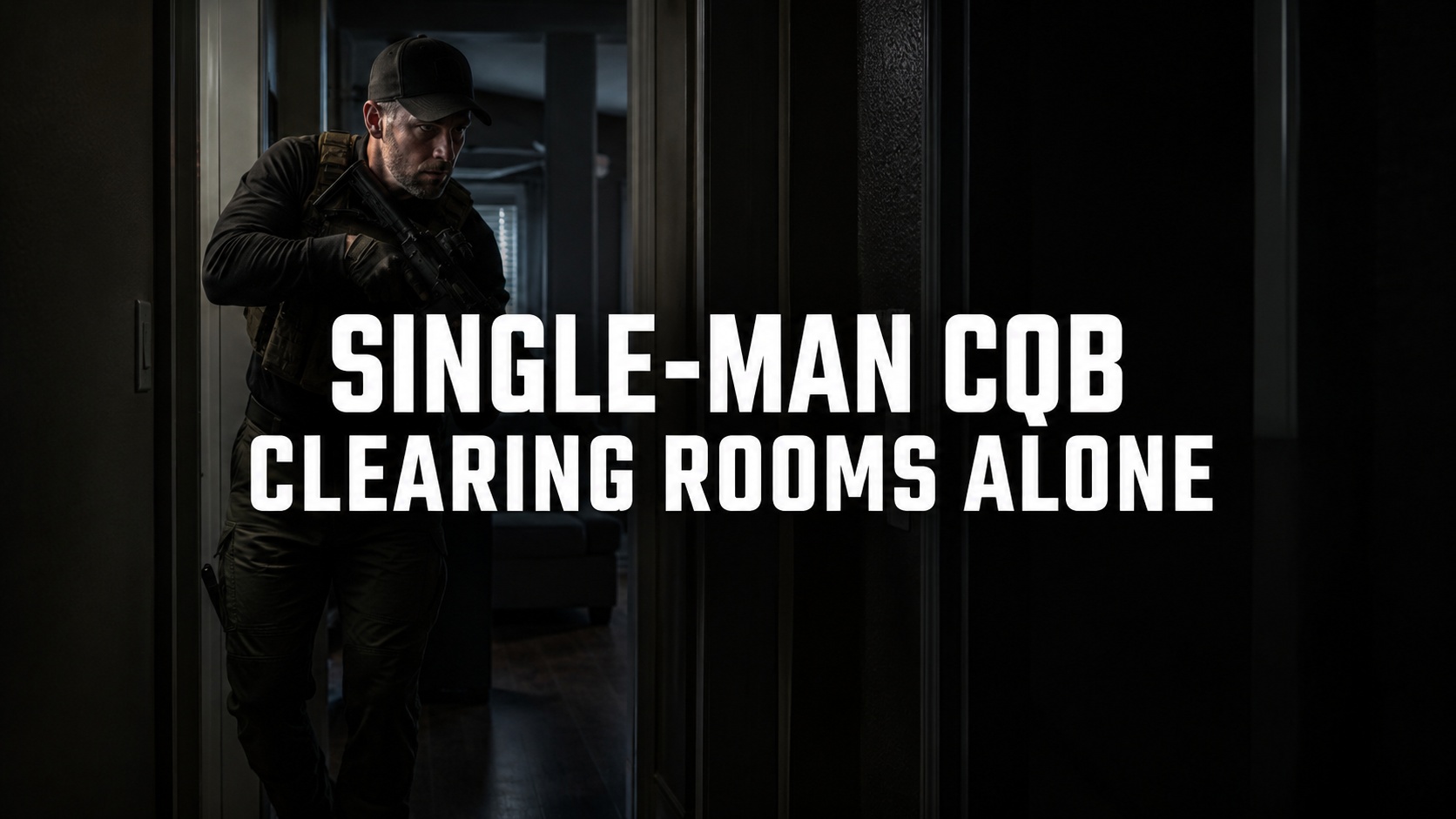
Clearing a building alone is one of the most dangerous tasks an armed person can attempt.
You have no partner watching your back. No second set of eyes covers the angles you cannot see. Nobody manages the hallway while you check a room. Every doorway, corner, closet, and piece of furniture can conceal a threat.
That is why single-man CQB is generally not advised.
For a civilian facing a suspected break-in, the preferred response is usually simple. Get your family behind a locked or barricaded door. Call emergency services. Establish a defensible position. Clearly identify anyone who approaches. Let trained officers search the structure.
Do not go hunting through your house merely because you heard a noise.
There may still be circumstances where movement becomes necessary. A child may be in another room. A family member may be injured. Smoke or fire may block the safest exit. You may need to reach an exterior door, retrieve someone, or escape an immediate threat.
In those rare moments, preparation matters.
The objective is not to act like an assault team. It is to reduce exposure, gather information, avoid unnecessary contact, and move toward safety.
Why Clearing Alone Is So Dangerous
A tactical team divides responsibility.
One person may observe the near corner. Another watches deeper into the room. Someone else controls the hallway or rear security. Team members communicate and cover one another.
A lone person has 360-degree responsibility.
That is the central problem.
You can only look in one direction at a time. While you examine a doorway, the hallway behind you may remain unsecured. When you enter a room, you may expose yourself to several unseen areas at once.
The structure itself creates more problems.
Walls limit vision. Doorways channel movement. Furniture creates hiding places. Mirrors and glass cause confusion. Darkness reduces identification. Noise may come from a different location than expected.
A familiar house can also become unfamiliar under stress.
Lights may be off. Doors may be partly open. Furniture may have shifted. Adrenaline can distort time, hearing, and distance. A hallway you walk through every day can feel completely different at 2:00 a.m.
This is why confidence must never be confused with competence.
The Threshold Is the Problem
A doorway is more than an opening between rooms.
It is a threshold between what you can see and what you cannot see.
The person approaching the doorway usually has limited information. Someone inside the room may already be watching the opening. That creates an advantage for the person who is waiting.
Doorways also act as funnels.
People tend to appear in the center of them. They pause there. They lean into the room. They push their head, hands, or equipment through before the rest of the body follows.
That creates exposure.
Good threshold awareness begins with one principle: do not place more of yourself into an unknown area than the situation requires.
Observation should come before commitment.
What “Pie the Door” Means
To “pie the door” means gradually increasing your view into a room while remaining outside it.
The doorway is treated like the center of a pie. The visible area is divided into narrow slices. As the observer changes position, another small section of the room becomes visible.
The purpose is information.
Pieing can help reveal open floor space, furniture, additional doors, and parts of the room that would otherwise remain hidden. It may allow someone to examine much of an area before crossing the threshold.
It does not make the room safe.
A person can still be concealed behind furniture, inside a closet, close to the wall, or beyond another opening. Shadows may hide movement. A threat may also see part of you before you see all of them.
Pieing the door is an observation concept, not a magic trick.
The main lesson is to use distance and angles to gather information before moving into an unknown space.
Center-Fed Doors
A center-fed door is positioned near the middle of a wall.
This layout can expose the person at the doorway to significant unknown space on both sides. There may be a deep corner to the left and another to the right. The room may also continue directly ahead.
That creates competing areas of concern.
You cannot observe both sides at the same time. Looking toward one side means giving less attention to the other. Crossing the doorway may expose you to multiple angles at once.
Center-fed doors demand caution because neither side of the room is naturally limited by the doorway’s position.
For a lone civilian, this should reinforce the case for staying outside the room whenever possible.
Use available information. Listen. Look for movement. Consider whether entering is truly necessary.
Often, it is not.
Corner-Fed Doors
A corner-fed door sits close to one corner of the room.
This changes the geometry.
One side may contain little or no hidden space because the doorway is close to the adjoining wall. Most of the unknown area may extend in the opposite direction.
That can make the room easier to understand from outside.
It does not make it safe.
The visible corner may contain furniture, an offset wall, another doorway, or a recessed area. The room could be L-shaped. The apparent corner may not be the actual end of the space.
Labels help organize what you see. They do not replace observation.
Whether a door is center-fed or corner-fed, assume the unseen space remains unsecured until proven otherwise.
Compressed Carry
Compressed carry is a close-retention firearm position used around tight spaces.
The firearm is kept close to the body rather than extended into the doorway or around a corner. The concept is meant to reduce snagging, prevent the weapon from entering an unseen area first, and make it harder for another person to grab.
This matters near doorframes, furniture, hallways, and other confined spaces.
An extended firearm can announce your position before you can see into the room. It may appear around a corner while your eyes and body remain hidden. Someone close to the doorway could then see or seize it.
Compressed carry addresses that specific problem.
It also requires professional instruction. Poor positioning can create serious muzzle-control problems. The firearm must never cover your own body, another household member, or anything you are not legally justified in threatening.
For most civilians, the important takeaway is not a specific pose.
It is the principle behind it: keep equipment controlled and avoid projecting it blindly into unknown space.
Slow Is Usually Better Than Rushed
Movies often show room clearing as a fast, aggressive action.
Real structures punish careless speed.
A lone person does not have teammates flooding the room, controlling separate angles, and identifying threats. Moving too quickly can cause missed details, poor identification, falls, collisions, and unsafe weapon handling.
Deliberate movement gives you time to think.
Stop. Look. Listen.
Use available light without becoming fixated on it. Pay attention to open doors, moving shadows, voices, alarms, pets, broken glass, and changes in the normal layout.
Speed may become necessary during an immediate emergency. Fire, an active attack, or an injured family member can force rapid decisions.
Until then, undue haste creates more problems than it solves.
Identification Comes Before Action
One of the greatest dangers in a home-defense incident is mistaken identity.
The person moving in the darkness may be a teenager coming home late. It may be a confused neighbor. It may be another armed family member responding to the same noise.
It may also be a police officer.
You must know what you are looking at. A shape, sound, or movement is not enough.
Positive identification matters legally, morally, and tactically.
Household members should know the emergency plan in advance. They should understand where to gather, what words to use, and what not to do. Avoid having multiple people independently searching the same structure with weapons.
That creates a blue-on-blue disaster inside your own home.
Communication is a force multiplier. Confusion is a threat.
Before You Leave a Secure Position
Ask several questions before moving.
Is anyone unaccounted for?
Is there a safe exit?
Can the person in the other room come to you?
Can you communicate by phone, alarm, camera, or voice?
Are emergency services already responding?
Is the danger moving toward you, or are you moving toward it?
Do you know where every family member is?
These questions can prevent an unnecessary search.
The safest move may be to stay in place, maintain cover, and provide emergency dispatchers with clear information.
Movement should solve a specific problem.
Never move simply because doing something feels better than waiting.
Cover, Concealment, and False Security
Homes contain plenty of concealment.
They contain far less true cover.
Interior doors, drywall, cabinets, couches, and ordinary furniture may hide you from view. Many will not reliably stop gunfire.
Do not assume that being unseen means being protected.
Structural elements may offer better protection, but construction varies. Brick, concrete, masonry, appliances, and heavily framed sections can behave differently under impact.
The civilian priority is still distance, escape, barriers, and communication.
A locked bedroom door with furniture pushed against it may provide time. Time allows police to arrive. It also forces an intruder to make noise and expose their intentions.
Sometimes the best tactical move is creating delay.
Common Single-Man CQB Mistakes
Entering Without a Clear Reason
Curiosity is not a mission.
Every additional room creates another set of unknowns. Do not clear areas that do not need to be entered.
Standing in the Doorway
The center of the doorway is predictable and exposed.
Avoid lingering in openings or using them as observation posts.
Focusing Only Forward
A lone person can become fixated on the room ahead while ignoring stairs, hallways, doors, and movement behind them.
There is no teammate providing rear security.
Letting Equipment Enter First
Hands, lights, or firearms that appear around a corner can reveal your location before you gain useful information.
Keep your equipment controlled.
Assuming a Familiar Layout Is Safe
Knowing the floor plan does not tell you where another person is standing.
Familiarity may reduce confusion, but it does not remove danger.
Failing to Identify the Target
Never act on a silhouette or unexplained movement.
Know what you are seeing.
Using Live Ammunition During Casual Practice
Improvised CQB practice with a loaded firearm is a recipe for tragedy.
Use professional facilities, qualified instructors, and dedicated inert training tools.
Training Without Creating Another Emergency
Single-man CQB should not be learned from articles or videos alone.
Written material can explain vocabulary and decision-making. It cannot evaluate muzzle discipline, judgment, balance, legal understanding, or how you respond under pressure.
Seek qualified instruction focused on lawful civilian defense.
Training should emphasize avoidance, safe storage, emergency communication, medical response, and family coordination. Building-clearing concepts should be taught in a controlled environment using inert replicas or dedicated training equipment.
Live firearms and ammunition should be removed from dry-practice areas.
Check again.
Then have another responsible person verify the area when possible.
Training should also include low-light identification, emergency calling, trauma care, fire evacuation, and interaction with arriving police. Those skills may be more useful than any doorway technique.
Build a Better Home-Defense Plan
The best single-man CQB strategy begins long before a break-in.
Strengthen exterior doors. Use quality locks and long screws in reinforced strike plates. Install exterior lighting. Trim vegetation that creates hiding places. Use alarms, cameras, and audible alerts.
Create a family rally point.
Choose a defensible room with a lock, phone access, medical kit, flashlight, and an alternate escape route when possible. Make sure children know where to go and what commands to follow.
Use simple code words.
Decide who calls emergency services. Decide who gathers children. Decide where firearms are stored and who may access them.
Rehearse the plan without weapons.
The goal is to reduce the chance that anyone will ever need to search the house alone.
When Movement Cannot Be Avoided
There may be a genuine emergency where staying put would leave someone in immediate danger.
In that case, keep the mission narrow.
You are not clearing the entire building. You are moving toward a person, an exit, or a defensible location.
Avoid distractions. Do not chase noises through unrelated rooms. Do not pursue someone who is leaving. Do not convert a rescue or escape into a search.
Maintain communication with emergency services when practical.
Tell dispatchers what you are wearing, where you are located, and whether you are armed. Follow their instructions. When officers arrive, understand that they may not know who the intruder is.
Do not surprise them with a firearm in your hands.
The Better Win
Single-man room clearing is not a demonstration of courage.
It is an emergency problem with poor odds.
Compressed carry, center-fed doors, corner-fed doors, threshold awareness, and pieing the door are useful concepts to understand. They explain how confined spaces restrict vision and create exposure.
They do not remove the danger.
The strongest civilian plan is built around avoidance, barriers, communication, identification, and escape. Secure the people who matter. Call for help. Hold a defensible position when possible.
Move only when staying would create the greater danger.
Plan before panic.
Survival is the mission. Everything else is secondary.
About the Author