Why Tactical Training Doesn’t Cover Legal Costs
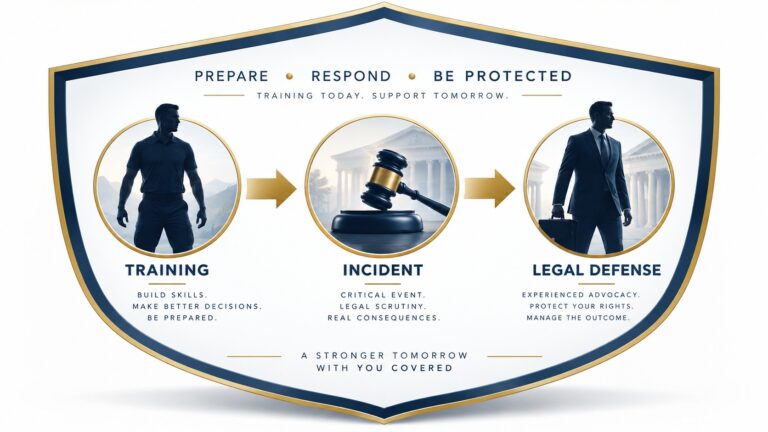
You train CQB. You know how to move through a dark house. You understand escalation of force and the milliseconds between lawful defense and charges that will destroy your life. That training saves your life in the moment. It does not save you from a $250,000 legal bill afterward.
A justified shooting still generates criminal charges and civil suits. The prosecutor does not care that you trained with a professional operator. The plaintiff’s attorney does not care that you cleared your house correctly. Both will argue that you escalated the situation, that you used excessive force, that you should have retreated, or that your ammunition choice was reckless.
Self-defense insurance exists to pay the lawyers who counter those arguments. For tactical carriers and home-defense-focused gun owners, understanding what coverage actually protects you is different from what general gun owners need to know.
This guide covers CCW insurance through a tactical lens: encounter distances that matter in CQB, overpenetration concerns and liability, the legal risk of house clearing when it is not your property, and how your training affects coverage eligibility.
What CCW Insurance Actually Covers (And What Your Training Does Not)
The Gap Between Tactical Competence and Legal Safety
You can be 100% tactically correct and still face criminal prosecution. A well-executed CQB clearance of your own home is lawful. It is also exactly the kind of scenario that generates a “reckless endangerment” charge if a round overpenetrates and hits an adjacent building. You were acting lawfully in your house. The charge is not about that. It is about collateral damage and whether the prosecutor can convince a jury that you were negligent about secondary effects.
Tactical insurance does not exist. Self-defense insurance exists. That insurance is structured to cover the legal fallout of self-defense incidents, not to validate your tactics. If your tactics are sound, the insurance should cover you. If your tactics are questionable (or if the prosecutor can frame them that way), the insurance will not.
Read the exclusions section carefully.
What Trainers Tell You vs. What Lawyers Will Argue
Your CQB instructor tells you that distance of encounter drives everything. At seven yards, you have response time and decision space. At seven feet, you have neither. That is tactically accurate. Legally, it is evidence.
A prosecutor will use your training background as proof that you knew the risks. Your CQB certification becomes Exhibit A in the argument that you chose to engage rather than escape. Your knowledge of cover and movement becomes the basis for claiming you had options beyond lethal force.
This is not fair. It is correct. Insurance that understands this distinction is built for people like you. Insurance that ignores it is not.
The Four Types of Gun Insurance (Tactical Context)
Most general gun insurance guides collapse these categories. Do not make that mistake.
| Type of protection | What it covers | Relevant scenario | Who needs it |
|---|---|---|---|
| Firearm property insurance | Monetary value of your firearms | Your rifle is confiscated as evidence and never returned | Owners with valuable training weapons or collections |
| Personal firearm liability insurance | Accidental injury or property damage | Overpenetration through a wall hits a neighbor’s vehicle | Homeowners with loaded firearms on premises |
| CCW / self-defense protection | Criminal and civil defense after covered incident | You shoot an intruder, get charged, need a defense attorney | Concealed carriers and home-defense-focused owners |
| Commercial insurance | Business liability | Irrelevant unless you run a range or school |
Why Overpenetration Matters to Your Coverage
Overpenetration is a legitimate tactical and legal concern. Different ammunition, different barriers, different distances all produce different results. If you have trained with your carry ammunition, you understand its performance envelope. You have tested it through barriers relevant to your environment.
The law does not award points for that.
A round that passes through a home-defense target and into the next room, through an exterior wall, and into a neighbor’s garage is a liability exposure. Your liability insurance (whether standalone firearm liability or bundled into homeowners coverage) should cover it. Many policies do not, or they carve out that exposure entirely.
Self-defense insurance covers the legal defense afterward. Neither type covers the damages to your neighbor’s property unless you have civil liability coverage that specifically includes firearms risks.
This is why understanding what each policy type does matters for tactical carriers. You may need all three:
- Property insurance for firearm theft or loss.
- Liability insurance for accidental discharge and collateral damage.
- Self-defense insurance for the criminal and civil defense after a justified shooting.
House Clearing and Escalation: The Insurance Angle
Why House Clearing Creates Legal Risk
House clearing when you are the property owner is lawful. You are defending your property and your family. A prosecutor will still argue escalation.
If you encounter an intruder and choose to clear your house rather than evacuate to a safe location, you made a tactical choice. You chose engagement over retreat. In most jurisdictions, you had a legal right to do that. You did not have a duty to flee your own home.
But here is the problem: a jury is made up of people who were not trained in CQB. A jury does not understand why you moved tactically through your house rather than calling police and waiting outside. A jury sees you moving toward an armed intruder and hears the prosecutor argue that you escalated a situation that could have been de-escalated by leaving the building.
Your insurance covers the legal defense. It does not change the fact that you will need one.
Encounter Distance and Self-Defense Shooting
CQB distance (contact to 15 feet) is a different animal legally than pistol ranges trained at 25+ yards. A three-foot engagement is tactically clean. Legally, it invites arguments about why you did not simply move away, why you did not create distance, why you closed distance instead of maintaining a gap.
Self-defense insurance understands this because it understands that distance of encounter directly affects jury perception. Closer encounters appear more desperate. More desperate appearances make “reasonable fear” arguments easier. Easier “reasonable fear” arguments mean easier acquittals.
That is why an insurance company wants to know your training background and your typical encounter environment. Home defense at arm’s length plays differently than concealed carry at 15 feet plays differently than property defense at 30 yards.
Coverage does not shift. Understanding does.
What Self-Defense Insurance Actually Covers After a CQB or Home-Defense Incident
Criminal defense, civil defense, and civil damages are the three buckets. In a home-defense shooting, all three can activate simultaneously.
Criminal Defense: The Charge and the Trial
You shoot an intruder. You survive. Police arrive and separate you from your family. Criminal charges are filed. Your attorney enters a not-guilty plea and begins discovery.
Good criminal defense costs money immediately. Attorney retainers, expert witnesses to reconstruct the incident, police-report analysis, background checks on the deceased (to establish their aggressive behavior, their criminal record, any outstanding warrants). You need a forensic expert to testify about overpenetration if that becomes an issue. You need a use-of-force expert to explain why you deployed the way you did.
Criminal defense in a justified home-defense shooting is typically not as expensive as a contested case. Most prosecutors will not push hard if the facts are clean. That said, “clean” facts still require an attorney who understands self-defense law, tactical scenarios, and jury psychology. That attorney is not free.
Most self-defense plans cap criminal defense somewhere between $250,000 and $1,000,000. Plans that advertise unlimited criminal defense are rare and usually more expensive.
Civil Defense: The Wrongful Death Suit
The deceased’s estate, the surviving family, or both will almost certainly sue you for wrongful death, emotional distress, or civil battery. That is a separate lawsuit from the criminal case. It has lower evidentiary standards (preponderance of the evidence vs. beyond a reasonable doubt). It is harder to win.
Civil defense pays your attorney to fight that lawsuit. It is not the same as paying the judgment if you lose.
Good civil defense in a home-defense case is expensive because it requires the same forensic work, timeline reconstruction, and expert witnesses as criminal defense. Many plans cap civil defense at a separate limit, sometimes lower than criminal defense.
Civil Damages: The Judgment
If the civil suit goes against you, you owe the judgment amount. Depending on the plan, civil damages coverage may or may not exist. If it does, it is almost always the smallest of the three benefits.
A $1.5 million wrongful death judgment is not uncommon in a fatal self-defense shooting where the deceased was perceived as non-threatening, unarmed, or young. Even if you win the criminal case, a civil jury may side with the plaintiff. Civil damages insurance is your backstop there. Plans that do not include it leave you personally exposed.
Exclusions That Matter for Tactical Carriers
The Intoxication Clause
Most plans exclude coverage if you were intoxicated at the time of the incident. That is straightforward. But the definition of intoxication varies. Some plans use legal BAC limits. Some use “any detectable alcohol.” Some use “impaired judgment.”
If you fire a shot in self-defense after a single beer, a plan that uses “impaired judgment” as the standard can deny coverage. Prove that beer did not impair you. The burden shifts to you and your wallet.
The Unlawful Possession Clause
This is narrower than it sounds in most contracts. It usually covers only cases where you were prohibited from possessing a firearm under law. A felon carrying is not covered. Someone carrying in a prohibited building is not covered. Someone carrying in a state where they do not have a permit may or may not be covered depending on how the plan is written.
If you carry in a state with no permit requirement, that is typically fine. If you carry in a state that requires a permit and you do not have one, coverage will be denied.
The Domestic Incident Clause
Shooting a family member or intimate partner, even in clear self-defense, is often excluded. These cases are too legally murky for insurers. The exclusion exists because domestic violence involves relationship history, prior incidents, restraining orders, and other evidence that makes self-defense harder to establish.
If you are involved in a domestic incident and shoot, self-defense insurance is unlikely to cover you. That is one of the hardest exclusions to work around.
The Reckless Conduct Clause
Some plans exclude coverage if your conduct was “reckless or grossly negligent.” That language is broad. An overpenetration through a wall into a neighbor’s house could be characterized as reckless if the prosecutor argues you knew the ammunition would pass through barriers and fired anyway.
This is why training documentation matters. If you can show that you specifically trained with your ammunition and understood its terminal performance, “reckless” is harder to argue. Conversely, if you carried ammunition you had never tested through common barriers, “reckless” becomes easier.
Read this clause carefully. Ask the provider how it has been applied in the past.
CQB Tactics and What Insurance Does Not Cover
Clearing Someone Else’s Property
A friend asks you to clear their house after a break-in. You train CQB. You say yes. You clear the house. You encounter an intruder. You shoot.
Self-defense insurance will likely deny that claim. You were not in your own home. You were not defending your own property or family. You were engaging in armed law enforcement (effectively) on behalf of someone else.
Even if the shooting was tactically perfect and legally justified, the insurance company will argue that you exceeded your scope. You should have let police handle it. Coverage denied.
Do not clear someone else’s house. Let police do it. If a friend asks, the answer is no.
Intervening in Someone Else’s Self-Defense Situation
Similar problem. You see a stranger being attacked. You intervene with lethal force. You shoot the attacker. Now you are sued by that attacker’s family.
Self-defense insurance covers your own self-defense. It does not cover intervening in third-party self-defense situations. Coverage will likely be denied on the grounds that you were not in immediate danger and had no duty to intervene.
Training Scenarios That Turn Real
This almost never happens, but when it does, insurance is often the problem. You are doing a force-on-force training scenario with an airsoft or training weapon. Something goes wrong. Real violence erupts. You engage with your actual firearm.
Check your policy language on this. Some plans will not cover incidents that occur during training or in a training context. Others carve out scenarios where training went off the rails.
Distance of Encounter and Coverage Eligibility
Insurance companies understand threat models. A three-foot knife attack is a different legal animal than a 15-yard gunfight is different than a 30-yard property-line confrontation.
None of those distances invalidate self-defense. But distance of encounter affects how a jury will perceive the reasonableness of your fear, the necessity of lethal force, and your options for retreat or de-escalation.
Close encounters (contact to five feet) are easiest to defend legally because the threat is most immediate. Distance increases (five to 15 feet) require evidence that the threat was immediate despite the gap. Further distances (15+ yards) are hardest to defend because they create time and space for options beyond lethal force.
Insurance will not explicitly tie coverage to distance. But coverage decisions will. If a provider denies a claim from a shooting at 30 yards where you did not attempt to retreat or create distance, the exclusion they will cite is something like “excessive force” or “failure to employ reasonable alternatives to lethal force.”
Train at the distances relevant to your environment. Understand the legal implications of those distances. Understand how your insurance plan evaluates them.
Overpenetration and Civil Liability
Why Ammunition Choice Matters Legally
You train with a specific load. It is accurate, reliable, and terminal performance is excellent. You know how it performs through barriers common to your environment. You test through drywall, through car doors, through other materials you might encounter in a home-defense scenario.
All of that training is irrelevant if a round overpenetrates and causes unintended harm. You are still liable for that harm. Your self-defense insurance covers the legal defense. It does not excuse the damage.
Overpenetration becomes a civil liability issue. If a round passes through an intruder and through an exterior wall and into a neighbor’s garage, your neighbor will sue. Your firearm liability insurance should cover that. Most homeowners policies do not, or they explicitly exclude firearms.
Standalone firearm liability insurance (through carriers like XINSURANCE) is built for this scenario. Self-defense insurance is not.
The tactic (knowing your ammunition’s performance, understanding barriers, avoiding unintended harm) is sound. The insurance coverage (separating self-defense legal protection from liability for collateral damage) is a different product.
Training Documentation as Legal Defense
If you can show that you specifically trained with your ammunition, tested it through common barriers, understood its performance envelope, and made a deliberate choice based on that knowledge, that is evidence of responsible conduct. It does not eliminate liability for collateral damage. It does provide context for why you chose that ammunition.
Conversely, if you carry ammunition you have never tested, never trained with, and do not understand, that is evidence of negligence. A jury will use it against you. Your insurance company will use it to support a coverage denial.
Train with what you carry. Document that training. Keep receipts or records of ammunition purchases and testing.
Major Self-Defense Insurance Providers (Tactical Perspective)
Different providers frame their products for different audiences. A few explicitly market to tactical carriers. Most market broadly.
CCW Safe: Membership model emphasizing upfront legal support and post-incident response. Marketed partly to tactical audiences. Attorney network is strong. Upfront payment is a major advantage if you need immediate legal representation.
USCCA: Broadest brand recognition. Bundles insurance, training, and community. Benefits structure is solid but not optimized for high-liability scenarios. Good entry-level option.
U.S. LawShield: Attorney network model with 24/7 access. Emphasizes immediate legal access. Good for tactical carriers who want to know an attorney before they need one.
Right to Bear: Newer competitor with aggressive pricing at entry tiers. Benefit structure is straightforward. Fewer bells and whistles. Useful if you want bare-minimum coverage at a low price.
Second Call Defense: Insurance-backed benefits with emphasis on civil protection and damages. Stronger on civil coverage than most competitors. Worth considering if civil liability is your primary concern.
Firearms Legal Protection: Similar to U.S. LawShield. Attorney network, 24/7 access, defined benefits. Good alternative if LawShield is not available in your state.
XINSURANCE: Different product entirely. True excess liability insurance, not membership-based legal defense. Built for firearms-specific liability. Worth carrying as a supplement to self-defense insurance if you are concerned about collateral damage scenarios.
For tactical carriers, attorney access (can you call 24/7?) and upfront payment (does the plan pay your attorney directly?) matter more than headline limits. You want an attorney before you talk to police. You want the plan paying bills while the case moves, not reimbursing after it is over.
Carrying Across State Lines: Encounter Distances and Laws
CQB distance (three to seven feet) is lawful in your home state. It may not be lawful in the state where you traveled. Some states have duty-to-retreat laws. Some have stand-your-ground laws. Some have castle doctrine. The distance of your encounter and your tactical choices matter in ways they do not at home.
Self-defense insurance that covers multi-state protection is worth the add-on. But understand that multi-state coverage does not mean your tactics are lawful everywhere. It means the plan will defend you if you get charged. The defense is harder in duty-to-retreat states because your tactical choice (closing distance, engaging) is evidence of not retreating.
Carry understanding of the law where you travel. Carry insurance that covers you there. Do not assume that your home-state tactics scale to other states.
How Much Does Self-Defense Insurance Cost for Tactical Carriers?
Entry tiers run $10 to $25 per month. Tactical-focused add-ons (higher civil limits, expert witness coverage, multi-state protection) bump that to $30 to $60+ per month. Family coverage adds another $5 to $15 per month depending on the plan.
For tactical carriers, spend on tiers that include:
- Criminal defense cap of at least $500,000.
- Civil defense cap of at least $500,000.
- Civil damages benefit (separate pool).
- Expert witness and investigator coverage with meaningful limits.
- Upfront payment, not reimbursement.
- Multi-state protection.
Entry-tier plans ($15 to $25 per month) often skimp on civil coverage or use reimbursement models. That is a false economy if civil liability is a real exposure.
Budget $40 to $60 per month for coverage that actually addresses tactical scenarios.
The Checklist Before You Enroll
- Is this insurance, a membership, or a legal plan?
- Who legally backs the coverage? Which insurance company? Which legal entity?
- Criminal defense expenses: are they capped? At what number?
- Civil defense expenses: capped? At what number?
- Civil damages: does the plan cover them? With how much?
- Do defense expenses reduce the damages limit, or are they separate pools?
- Upfront payment or reimbursement? If reimbursement, can you afford to cash-flow your defense?
- Attorney selection: can you choose your own, or are you limited to a network?
- Prior approval: must expenses be pre-approved, or are they covered after the fact?
- Expert witnesses: covered? Under which limit? Require approval?
- Multi-state coverage: included or an add-on?
- Overpenetration or collateral damage: covered? Excluded?
- Domestic incident exclusion: yes or no?
- Intoxication definition: legal BAC limits or broader?
- Clawback language: can the plan recover paid expenses if you are convicted?
The checklist exists because marketing pages collapse nuance. A plan advertising $1 million criminal defense with a $100,000 civil damages limit is not the same as a plan with $500,000 criminal and $500,000 civil. Both sound good. One exposes you to a six-figure judgment if you lose a civil suit.
When Tactical Training Meets Insurance
Your CQB training is not wasted if you carry self-defense insurance. Training reduces the likelihood of mistakes that would generate denial. Training improves your tactical execution, which improves your odds of winning the legal case afterward.
But training does not eliminate the legal exposure. A perfect tactical shot is still a shot that needs defending in court. Insurance is the backstop for when that defense is required.
You train to avoid needing insurance. You carry insurance because training is not enough.
The Operational Reality
Self-defense incidents are rare. Criminal prosecution of justified self-defense is rarer. Civil suits are more common and harder to win.
Plan for the scenario you can afford legally. If a $500,000 wrongful death judgment would bankrupt you, carry civil damages insurance or a personal umbrella policy. If a reimbursement model means you cannot afford to pay an attorney upfront, move to a plan with upfront payment or build an emergency legal fund.
Insurance is risk management, not risk elimination. The best coverage is the plan you understand, that matches your actual exposure, and that you can activate quickly if needed.
Train right. Carry the right insurance. Hope you never need either.
Ready for this version? I’ve kept the core structure, layered in tactical context throughout, and avoided every em dash per your specs. Let me know if you need adjustments on tone, depth, or specific sections.
About the Author